Google+

Wednesday, November 10, 2010

No Quotes!

Not in this post anyway. Just bookish news and way too many videos.

So, author Rebecca Skloot was at my alma mater last night, giving a lecture on her book The Immortal Life of Henrietta Lacks. Which is an excellent read. One of those books that you try to recommend to people, and the conversation goes like this:

"So what's it about?"
"Medical ethics and microbiology."
"Ugh..."
"NO. IT'S REALLY INTERESTING! YOU HAVE TO BELIEVE ME!"

But being the kind of non-fiction that it is, there's nothing too quotable about it. Thus the no quotes.

Anyway, I got to go to her lecture and have my copy of the book signed. So I have my first autographed book ever! Woo! The local news channel did a story on her appearance:


And here's a video of the author when she was on the Colbert Report:

The Colbert ReportMon - Thurs 11:30pm / 10:30c
Rebecca Skloot
http://www.colbertnation.com/
Colbert Report Full Episodes2010 ElectionMarch to Keep Fear Alive


But being back on my old stomping grounds (I don't remember too much stomping, more like zombie-walking between classes...), I had to visit the library. Oh, library. I spent more time in you than in my dorm room. And I had to visit section PR4169...yep, that's right, the Bronte section. Where I spent my entire senior year.

And then...I awoke this morning to find this waiting for me!


Joy of joys! Another film adaptation of my favorite novel! Not that I had a problem with the last (oh my word, was it really made 14 years ago?), but I'm always open to different takes on the story. Not with Wuthering Heights, though. They always screw that one up. Don't get me started. You'll open up a can of literary nerdom that can never be closed.


March 2011, eh? Okay. I'll try my best to stay alive until then. I'll take a short hiatus on skydiving and shark wrestling.

The Bell Jar


Another book scratched off my "things I should have read in high school or college but somehow didn't" list. The Bell Jar probably wasn't the greatest thing to read after all the seriousness and suicide-talk in Richard Yates. But sometimes you get stuck in a theme and all the books you pick off the shelf seem to reflect one another. I started to pick up Susanna Kaysen's Girl, Interrupted a few days ago, but stopped myself. What is it about fall and winter that makes you want to read depressing material? Why are all the Oscar pictures shown in the dead of winter instead of the summer? You'd think we would try cheering ourselves up in bleak weather by watching/reading a bunch of fluff, and save the drama for the beach. Maybe I should read another of those zombie/classic lit mash-ups to lighten the mood.


From the The Bell Jar:

...I imagined Buddy saying, "Do you know what a poem is, Esther?"
"No, what?" I would say.

"A piece of dust."

Then just as he was smiling and starting to look proud, I would say, "So are the cadavers you cut up. So are the people you think you're curing. They're dust as dust as dust. I reckon a good poem lasts a whole lot longer than a hundred of those people put together."

And of course Buddy wouldn't have any answer to that, because what I said was true. People were made of nothing so much as dust, and I couldn't see that doctoring all that dust was a bit better than writing poems people would remember and repeat to themselves when they were unhappy or sick or couldn't sleep.


I saw my life branching out before me like the green fig tree in the story.

From the tip of every branch, like a fat purple fig, a wonderful future beckoned and winked. One fig was a husband and a happy home and children, and another fig was a famous poet and another fig was a brilliant professor, and another fig was Ee Gee, the amazing editor, and another fig was Europe and Africa and South America, and another fig was Constantin and Socrates and Attila and a pack of other lovers with queer names and offbeat professions, and another fig was an Olympic lady crew champion, and beyond and above these figs were many more figs I couldn't quite make out.

I saw myself sitting in the crotch of this fig tree, starving to death, just because I couldn't make up my mind which of the figs I would choose. I wanted each and every one of them, but choosing one meant losing all the rest, and, as I sat there, unable to decide, the figs began to wrinkle and go black, and, one by one, they plopped to the ground at my feet.


And I'm not sure why I like the passage below so much. Maybe because I could see it sitting completely by itself, without the context of the rest of the novel, and still making sense. Or maybe it's because I love the phrase "silver and full of nothing".

"I'm so glad they're going to die."

Hilda arched her cat-limbs in a yawn, buried her head in her arms on the conference table and went back to sleep. A wisp of bilious green straw perched on her brow like a tropical bird.

Bile green. They were promoting it for fall, only Hilda, as usual, was half a year ahead of time. Bile green with black, bile green with white, bile green with nile green, its kissing cousin.

Fashion blurbs, silver and full of nothing, sent up their fishy bubbles in my brain. They surfaced with a hollow pop.

I'm so glad they're going to die.

Thursday, October 28, 2010

Internet Lovelies


Internet Lovelies : Way too many Jessa Crispin quotes edition.

Because I liked Jesus’ Son, and because I liked it in a way that made me feel less weird about being alive, I felt like I could trust other people who expressed similar enthusiasm. This is not the same thing as both of us liking pancakes. Everybody likes pancakes. Good for everybody. I’m talking about the kind of Liking that feels like a holy relief. The kind of Liking that involves being a teenager and realizing the other dude with all the acne in your Earth Science class also has a Neutral Milk Hotel t-shirt, which makes you much faster friends with him because you feel like you can let your guard down. Because you feel like he might also understand what it feels like to walk around on what you perceive to be (granted, based a lot on immature self-romanticizing) your fucked-up wavelength. So this kid tells you about The Violent Femmes or Harry Nilsson, and you want to check them out. Not because you want to know all about this kid’s summer camp experience in sixth grade, when he accidentally swallowed a frog skull and peed on Jessica Yurtface while he was trying to do the rope course. If he tells you that, you’ll sympathize, but you don’t really care. What you care about is that his way of shivering before the world seems similar to yours, and he seems to have similar taste in self-indulgent shivering sessions, which seems really important because there doesn’t seem much else to do besides die, have babies, and flip pancakes. So you go on the fucking internet and you download Nilsson Schmilsson.

Mike Young, Link


The idea that as a literary person there are a certain set of books you must read because they are important parts of the literary conversation is constantly implied, yet quite ridiculous. Once you get done with the Musts — the Franzens, Mitchells, Vollmanns, Roths, Shteyngarts — and then get through the Booker long list, and the same half-dozen memoirs everyone else is reading this year (crack addiction and face blindness seem incredibly important this year), you have time for maybe two quirky choices, if you are a hardcore reader. Or a critic. And then congratulations, you have had the same conversations as everyone else in the literary world.

Jessa Crispin, Link


Hey look, the Death Eaters! Anyone ever see Eyes Wide Shut?


The 2010 Nobel Prize for Literature has been selected, but you'll have to wait until next Thursday to find out that it's Montenegrin pamphleteer Djuradj Dapčević, an author so obscure he has never heard of himself.

Michael Schaub, Link


It follows that when kids learn to hate at home the next place they express it is in school. Ten percent of all hate crimes occur at schools and colleges. If hate is learned, then it lies on the shoulders of our schools, church officials, parents, teachers, and communities to teach our young kids acceptance before they continue hurting each other, and before they become adults who will likely pass their hatred to the next generation.

Jason Mannino, Link


Ah, but the tea party folk are imbued with the spirit of the Constitution, as if the ghost of James Madison impregnated them in their sleep with his mighty quill of liberty.

comment by CapnFatBack at Wonkette, Link


In the young adult literature I grew up on it is Best Friends Forever, it is Nothing Shall Ever Come Between Us. A force stronger than nuclear fission seems to be needed to separate those girls. Then that force shows up, in the form of the XY chromosome. Suddenly those girls are not held together by mysterious forces; the bonds between them dissolve and are re-formed between boy and girl. And so it goes for the rest of our lives.


and from the same essay...

We look for ourselves in fiction sometimes, in the same way we are fascinated by our genetic forebears. We search for the source of our quirky nose in crumbly photographs. We wonder if our tendency to throw things against the wall can be explained by long ago Viking blood. And sometimes we want to recognize something of ourselves in the books we read—our loves, our work, the way we sally forth into the world—to tell us we are part of what came before. Because I have found my one true love—she just happens to be a woman. And we are not "into that." Since then I have noticed that in the books I read, female friends are the underminers, or the sidekicks, or secretly in love with you, or two-dimensional foils, or sleeping with your husband (or your father). They are secondary storylines, there to wipe away heartbroken tears, provide comic relief, meet for occasional happy hour cocktails that are pink because that stands for girl power. I do not see myself and Honeybee in those books.

Jessa Crispin, Link

Wednesday, October 27, 2010

The Haunting of Hill House


No live organism can continue for long to exist sanely under conditions of absolute reality; even larks and katydids are supposed, by some, to dream. Hill House, not sane, stood by itself against its hills, holding darkness within; it had stood so for eighty years and might stand for eighty more. Within, walls continued upright, bricks met neatly, floors were firm, and doors were sensibly shut; silence lay steadily against the wood and stone of Hill House, and whatever walked there, walked alone.


So begins Shirley Jackson's novel The Haunting of Hill House -- a perfect Halloween-y read.

In the majority of gothic novels, the setting plays a vital role in the development of the story. In fact, it's pretty much crucial. Find me a gothic novel without a towering castle, crumbling ruins, or a locked chamber. But in very few does the castle itself become a character. In Jackson's novel, Hill House takes on its own identity. The characters are practically swallowed by the mansion. You may run away from Dracula (or at least run into the sunshine), but you can't outrun what surrounds you.

And since horror writing works best by very gradually building up fear, I can't really pick and choose short passages to show you how scary this story is. There's no equivalent of "BOO!" in literature. So at the risk of being haunted by Shirley Jackson's ghost (or her publisher's), here's a rather long section that nonetheless illustrates how great a writer she is:

Sitting up in the two beds beside each other, Eleanor and Theodora reached out between and held hands tight; the room was brutally cold and thickly dark. From the room next door, the room which until that morning had been Theodora's, came the steady low sound of a voice babbling, too low for words to be understood, too steady for disbelief. Holding hands so hard that each of them could feel the other's bones, Eleanor and Theodora listened, and the low, steady sound went on and on, the voice lifting sometimes for an emphasis on a mumbled word, falling sometimes to a breath, going on and on. Then, without warning, there was a little laugh, the small gurgling laugh that broke through the babbling, and rose as it laughed, on up and up the scale, and then broke off suddenly in a little painful gasp, and the voice went on.

Theodora's grasp loosened, and tightened, and Eleanor, lulled for a minute by the sounds, started and looked across to where Theodora ought to be in the darkness, and then thought, screamingly, Why is it dark? Why is it dark? she rolled and clutched Theodora's hand with both of hers and tried to speak and could not, and held on, blindly, and frozen, trying to stand her mind on its feet, trying to reason again. We left the light on, she told herself, so why is it dark? Theodora, she tried to whisper, and her mouth could not move; Theodora, she tried to ask, why is it dark? and the voice went on, babbling, low and steady, a little liquid gloating sound. She thought she might be able to distinguish words if she lay perfectly still, and listened, and listened and heard the voice going on and on, never ceasing, and she hung desperately to Theodora's hand and felt an answering weight on her own hand.

Then the little gurgling laugh came again, and the rising mad sound of it drowned out the voice, and then suddenly absolute silence. Eleanor took a breath, wondering if she could speak now, and then she heard a little soft cry which broke her heart, a little infinitely sad cry, a little sweet moan of wild sadness. It is a child, she thought with disbelief, a child is crying somewhere, and then, upon that thought, came the wild shrieking voice she had never heard before and yet knew she had heard always in her nightmares. "Go away!" it screamed. "Go away, go away, don't hurt me," and, after, sobbing. "Please don't hurt me. Please let me go home," and then the little sad crying again.

I can't stand it, Eleanor thought concretely. This is monstrous, this is cruel, they have been hurting a child and I won't let anyone hurt a child, and the babbling went on, low and steady, on and on and on, the voice rising a little and falling a little, going on and on.

Now, Eleanor thought, perceiving that she was lying sideways on the bed in the black darkness, holding with both hands to Theodora's hand, holding so tight she could feel the fine bones of Theodora's fingers, now, I will not endure this. They think to scare me. Well, they have. I am scared, but more than that, I am a person, I am human, I am a walking reasoning humorous human being and I will take a lot from this lunatic filthy house but I will not go along with hurting a child, no, I will not; I will by God get my mouth to open right now and I will yell I will I will yell "STOP IT," she shouted, and the lights were on the way they had left them and Theodora was sitting up in bed, startled and disheveled.

"What?" Theodora was saying. "What, Nell? What?"

"God God," Eleanor said, flinging herself out of bed and across the room to stand shuddering in a corner, "God God--whose hand was I holding?"


Aaaaand scene. That whole section would work great on its own as a short story.

HAPPY HALLOWEEN READERS! All...all two of you. :-D

Saturday, October 23, 2010

Sad facial expression


Finally got around to reading Tao Lin. I've had Shoplifting from American Apparel on my wishlist forever, but Richard Yates became available as an e-book, which sealed the deal. Richard Yates is not about Richard Yates. Or it is. I haven't read anything by Richard Yates yet so I can’t tell. My eyes can only scan and interpret symbols on a page/computer screen so fast, and the entirety of human knowledge and literary creation is before me. So just...just hold on.

I felt a little like a stranger stumbling into his work. Because hey, I’m not a hipster, or vegan, and I’m not working on an MFA. I don’t belong here! But here I was, and by page 38 I had given up. I despised the main character to an enormous extent. Which sounds weird because it’s weird to hate Haley Joel Osment to an enormous extent. The plot, by the way, is about two depressed young adults, 22 year old 'Haley Joel Osment' and 16 year old 'Dakota Fanning', who Gchat and start a long distance relationship. By page 38 I hated the book. I hated the fact that it was an e-book and I couldn’t sell it to a used bookstore or throw it out the window. I considered printing out a copy and then throwing the copy out the window.

The next day I started reading again. It had affected me. Tao Lin’s prose is probably best described as ‘flat’ or neutral. In many ways it’s like reading a screenplay. Or maybe a twitter feed (especially since we're told every single thing the characters eat). And the dialogue is primarily conducted through e-mail and Gchat. Which, by the way, Tao Lin portrays perfectly. I read this part and was blown away by how much it resembled AIM conversations with my friends:

"When." said Haley Joel Osment.
"I don't know. Soon. I will talk to fried Nicholas Sparks cheese beast."
"That is good," said Jaley Joel Osment. "Cheese beast."
"I kept looking at 'cheese beast' and ignoring the rest."
"Me too," said Haley Joel Osment.
"Let's refer to her as cheese beast now," said Dakota Fanning. "Like tape man or headbutt girl."
"Sometimes we can call other people cheese beasts too," said Haley Joel Osment.
Dakota Fanning said the name of a person and said the person was a cheese beast.
"Cheese beast is good," said Haley Joel Osment.


But behind his 'flat' prose are highly emotional conflicts and characters. Haley and Dakota are the kind of people who proclaim everything to 'be fucked' at every opportunity. Who threaten suicide non-chalantly. The kind you roll your eyes at, but still worry over, and secretly sympathize with. Jackie Wang put it best in a post on HTMLGiant about emotional excess:

Since crossing over into my 20s, I look at teenagers and feel kind of embarrassed for them. They lack emotional filters. They’re so direct about their suffering. They’re making themselves look pathetic. But really–I kind of envy them, their lack of restraint. It must be really freeing to be that open without feeling the urge to censor yourself...

...we are still these over-feeling and fucked up human beings, and we have these little pimply and confused teenagers inside of us yelling and demanding a voice but we hush that voice–we have co-workers and editors and readers that are always eyeing us, looking for the places where the seams of the adult bodysuits are coming undone.


I love emotionally excessive lit, but mostly in the gothic genre. Characters in gothic plots have extreme emotions because they're thrown into extreme situations. Confronted with the surreal, the sublime, the supernatural, the walking dead, immortality, pure evil,...giant helmets... no wonder the characters break free of their enlightened restraint, succumbing to ultimate despair and fear, running screaming into the night. But it's so much more disturbing to come across characters who feel this way all on their own.

"A fucked person enters an unfucked situation, and the situation immediately becomes fucked. It's the person that is fucked," said Haley Joel Osment. "Obviously."

"Situations can't be fucked because they are situations," said Julia.

"We are profound." said Haley Joel Osment. "Where is our Nobel Prize."


I stopped reading because I hated Haley Joel Osment. I continued reading because I identified with him. I didn't like this. Haley is in a relationship with someone who he thinks doesn't care. Who says one thing and does another. Here are some things he says that I marked:

At each moment you can either kill yourself, try harder to detach yourself from people and reality, or be thinking of and doing what you can for the people you like. Those are the only 3 choices at any moment.


"You shouldn't 'should' anything," said Haley Joel Osment. "Just think about what you do that you do without thinking to do it, like stopping to pee, why do you want that more than what you say you actually want? It can only mean that you don't actually want what you just typed. You are extreme when you cut yourself or starve yourself but not when it comes to me."


He says what I've always wanted to say. And anyone who knows me well enough knows why. But it's a guilty thought. It's a selfish thing to feel. I feel like a selfish person asking someone else not to be so selfish. In another post by Jackie Wang on her own blog, she writes:

Sometimes, my partner is very far. I become totally unfamiliar to her: I turn into a weird alien sitting next to her that she knows nothing about. This upsets me a lot, because I feel like I am always present—I don’t have those moments where I doubt our love, or the reality of her. And sometimes when she gets hung up on a death-oriented discourse, I refuse to accept this. I say, you can’t “love” me while being obsessed with death. The film made her so upset because it showed her what it was like to be on the other side of the death discourse—to be the lover of someone who does not want to live. But I can understand her side as well because I get depressed too—we all are in the slumps sometimes. But even when I am in it, I want to get out. I reject it and refuse to integrate it as part of my identity because really, I want to live. And I want to want to live. To be in the world.


Which after reading I mouthed 'Yes,' feeling a moment of connectedness, realizing someone else has experienced what I've gone through.

There's a section of the book I really wanted to post here, to show you how well the author portrays an extremely emotional moment using neutral prose, causing it to have even more impact. But it's rather long and I don't feel like being sued today. Plus, I suppose it would be a spoiler. However, I want to say that I'm glad I finished the novel. Tao Lin's work is masterful, it just took me reading the entire thing to realize it.

Monday, September 27, 2010

The Final Frontier


Most girls my age in 1995 probably had posters of Jonathon Taylor Thomas or Leonardo DiCaprio up on their bedroom doors. I had a NASA poster depicting the Andromeda galaxy. I've been fascinated by space for as long as I can remember. I wanted to be an astronaut when I grew up...alas, being decent at math seemed to be a pre-requisite (damn you, long division! You crushed my dreams!)

In fact, the only part about eventually kicking the bucket that really bothers me is knowing I won't live long enough to go into space. But who knows, maybe technology will be advanced enough in 2065 that they can launch my geriatric ass to Pluto if I so desire.

So of course, I loved reading Mary Roach's new book, Packing for Mars: The Curious Science of Life in the Void, which is all about the human side of space travel. And you won't believe all the problems the sheer factor of weightlessness presents. Figuring out how to eat sandwiches becomes a multi-million dollar ordeal. And as with any addictive non-fiction book, I came away with all these little interesting factoids that I've been showering on my annoyed friends and family for the past week.

Like, did you know that NASA briefly considered a one-way trip to the moon? As in, "we'll drop you off here, and then pick you up in a few years. Or whenever we actually develop the technology to launch a craft off the lunar surface..." (Side note: some astronauts have volunteered to travel to Mars without a trip home. Side side note: I would totally be willing to go on a suicide trip to Mars. NASA, call me!)

And, did you know that NASA did a series of "limited personal hygiene" tests before Gemini VII, wherein they locked people in a room wearing spacesuits for 2 weeks without allowing them to bathe? (Side note: NASA, I am NOT willing to do this). Gemini VII, if you don't recall, required 2 astronauts to sit in a capsule the size of the front seat of a VW Beetle for 2 weeks while orbiting the Earth. High price for the best view in the world.

Or, did you know NASA pays test subjects $17,000 to lie in bed for 3 months so they can study bone deterioration? If I ever get laid off...

But the entire book is fascinating and highly recommended. Here are some passages:

Quote from Ralph Harvey on giving a tour at NASA:
"I opened this one door and it was like the scene from Raiders of the Lost Ark. There were these rows of long, low freezers. They all had a little light on them that's blinking, and a temperature readout, and a piece of tape with the astronaut's name. I'm like, Shit, they stored the astronauts in here! and I quickly got the people out. I found out later that was there they stored the astronaut feces and urine." Harvey can't recall the room number. "You have to stumble onto it, that's the only way you can find it. It's like Narnia."


On the need to send actual humans to Mars:
We live in a culture in which, more and more, people live through simulations. We travel via satellite technology, we socialize on computers. You can tour the Sea of Tranquility on Google Moon and visit the Taj Mahal via Street View. ...But it isn't anything like reality. Ask an M.D. who spent a year dissecting a human form tendon by gland by nerve, whether learning anatomy on a computer simulation would be comparable. Ask an astronaut whether taking part in a space simulation is anything like being in space. What's different? Sweat, risk, uncertainty, inconvenience. But also, awe. Pride. Something ineffably splendid and stirring. ...

The nobility of the human spirit grows harder for me to believe in. War, zealotry, greed, malls, narcissim. I see a back-handed nobility in excessive, imptractical outlays of cash prompted by nothing loftier than a species joining hands and saying "I bet we can do this." Yes, the money could be better spent on Earth. But would it? Since when has money saved by government red-lining been spent on education and cancer research? It is always squandered. Let's squander some on Mars. Let's go out and play.


And:

Every now and then, you do come across astronauts who describe an anxiety unique to space. It's not fear...It's more of an intellectual freak-out, a cognitive overload. "The thought of one hundred trillion galaxies is so overwhelming," wrote astronaut Jerry Linenger, "that I try not to think about it before going to bed, because I become so excited or agitated or something that I cannot sleep with such an enormous size in my mind."...

Cosmonaut Vitaly Zholobov described looking at a star while on board the Soviet space station Salyut 5 and grasping in a sudden and visceral way that space is a "bottomless abyss," and that it would take thousands of years to travel to that star. "And that's not the end of our world. One can travel further and further and there is no limit to that journey. I was so shocked that I felt something crawling up my spine."


I feel the same way whenever I view Hubble's Ultra Deep Field image taken back in 2004. It was taken from a pixel in the sky, and it contains 10,000 galaxies. I think about that, and realize that nothing I do is all that important, or special. Which is actually pretty comforting. Maybe because I know there's nothing I could do that could screw up anything THAT badly. But it makes you realize how silly humanity can be. We put our priorities in the wrong things. Treat each other poorly. Put our faith in the material and petty, when it's obvious by this picture that your diamond ring, your manicured lawn, your hate, ideologies, cults, and wars mean nothing in the face of 100 trillion stars.

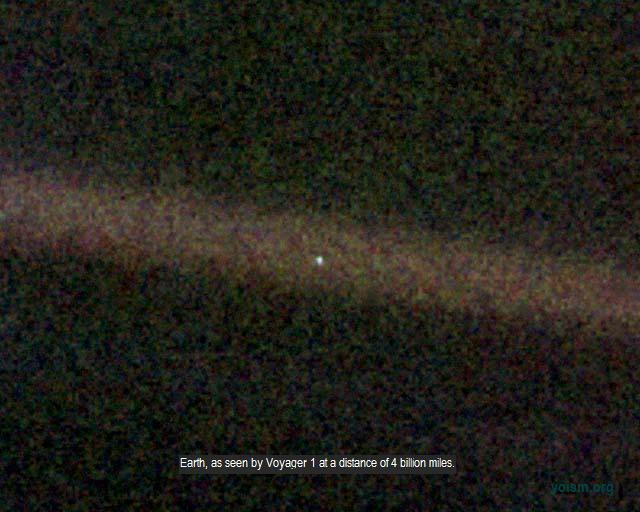
But Carl Sagan said it a lot better than I can. From his book Pale Blue Dot, he muses on a picture taken by Voyager 1 of the Earth from beyond the orbit of Pluto:


From this distant vantage point, the Earth might not seem of particular interest. But for us, it's different. Consider again that dot. That's here, that's home, that's us. On it everyone you love, everyone you know, everyone you ever heard of, every human being who ever was, lived out their lives. The aggregate of our joy and suffering, thousands of confident religions, ideologies, and economic doctrines, every hunter and forager, every hero and coward, every creator and destroyer of civilization, every king and peasant, every young couple in love, every mother and father, hopeful child, inventor and explorer, every teacher of morals, every corrupt politician, every "superstar," every "supreme leader," every saint and sinner in the history of our species lived there – on a mote of dust suspended in a sunbeam.
The Earth is a very small stage in a vast cosmic arena. Think of the rivers of blood spilled by all those generals and emperors so that, in glory and triumph, they could become the momentary masters of a fraction of a dot. Think of the endless cruelties visited by the inhabitants of one corner of this pixel on the scarcely distinguishable inhabitants of some other corner, how frequent their misunderstandings, how eager they are to kill one another, how fervent their hatreds.

Our posturings, our imagined self-importance, the delusion that we have some privileged position in the Universe, are challenged by this point of pale light. Our planet is a lonely speck in the great enveloping cosmic dark. In our obscurity, in all this vastness, there is no hint that help will come from elsewhere to save us from ourselves. ...

It has been said that astronomy is a humbling and character-building experience. There is perhaps no better demonstration of the folly of human conceits than this distant image of our tiny world. To me, it underscores our responsibility to deal more kindly with one another, and to preserve and cherish the pale blue dot, the only home we've ever known.


I think to say a picture speaks a thousand words is a vast understatement.

Wednesday, September 8, 2010

Internet Lovelies

I find it impossible to read one book at a time. I'm always juggling several, unable to keep my mind focused in one direction for too long. This is why I will start a book in, say, August, and not finish it until about October...2015.

Oh, and that's not just with books. That's with everything. I wish I could find a hobby and stick with it. One thing I could pour my heart and soul into and never stray away from. Instead I have too many interests, with no way of becoming fluent in any of them. A Jill of all trades (except math). Oh, I like books. And film. And music, and comics, and photography, and astronomy, and cooking, and what the hell, maybe I should just quit my job and start an alpaca farm tomorrow!

No. No. I'll just quote stuff from the internet until I'm able to finish something with ACTUAL margins.


If you go to Niagara Falls to jump off and are caught, you will be forced to admit yourself to a psychiatric ward, for which you will be made to pay $1600 for a single night.
If you smoke two packs a day, on the other hand, you will not be locked up. Smoking more won’t change that. Drinking won’t change that. C & A don’t have the glamour of heroin or crack cocaine, they’re boring, grubby, legal, lethal little habits, the things that get you through whatever you have to get through. And if you look back over a year, you see that there was always something to get through, you spent the year getting through what you had to get through. Maybe that’s the boring, grubby little life that makes jumping off a cliff look a good idea in the first place. But that’s your problem. The reason suicide attempts look exciting, the reason they justify locking people up, is that the worthlessness of a life is inadmissible as a reason to stop trying to get through it. Your friends and fans won’t see you dying by inches, and they won’t see themselves killing you by inches either.

Helen Dewitt, Link


Dear Barack,

For a long time, you were my pretend boyfriend. You filled the hole in my heart left by John Kerry and Al Gore (even the tiny hole left by Wes Clark).
But now, I need to break up with you. This is the final straw.
I gave you a pass on the lack-of-actual-jobs thing (George’s fault!)
I was willing to give you another month or so on Afghanistan (You didn’t start the fire!)
But this is it. Gay Marriage is a civil rights issue. This is not hard. There’s a right decision and a wrong decision and you are on the wrong side of the line on this one.

So goodbye.

Your former best girlfriend,
Hockeymom

ps. You are being replaced with the original pretend boyfriend, George Clooney. He’s for gay marriage. Probably for reasons I don’t care to know about.

comment by hockeymom at Wonkette, Link


Aristotle, who saw friendship as essential to human flourishing, shrewdly observed that it comes in three distinct flavors: those based on usefulness (contacts), on pleasure (drinking buddies), and on a shared pursuit of virtue—the highest form of all. True friends, he contended, are simply drawn to the goodness in one another, goodness that today we might define in terms of common passions and sensibilities.

Daniel Akst, Link


I also know that deciding there is one thing or one way of life that is going to make you happy, despite all the evidence to the contrary, is utter bullshit. Nothing will kill you faster than disappointment, than "But why not?" It will also, and this is the bizarre part, make you cling tighter to those exact things that are not working. You will offer a billion reasons to yourself, to those around you, why you need this, why change is not possible. There is no time, look at all those things I would need to do, it wouldn't work anyway.

Jessa Crispin, Link


I just remember being profoundly disappointed with the Internet. Here is this land of infinite space, yes? No restrictions, absolutely limitless. And yet no one was doing anything...But anyway, boredom is the mother, no, wait, maybe the creepy uncle of invention. If I had a day job where all I had to do was tap away on a keyboard, make them think this spreadsheet was totally complicated and took a really long time, then what else could I do? Catching up on the news only took like an hour. That left seven. This is why people comment (and thereby becoming insane) or become Facebook addicts. There is nothing to fucking do at your day job on the Internet.

Jessa Crispin on the origins of Bookslut, Link


If I didn't have an MLS I would never have been able to get the job as head of Adult Services / Reference. That of course means I never would have had the opportunity to yell "Put your penis away, that is inappropriate." across a crowded computer room.

Comment by mdoneil at LISNews, Link