Google+

Thursday, December 15, 2011

A Clockwork Orange, 68/100

What could I possibly say about Anthony Burgess' A Clockwork Orange that hasn't been said before? Beats me. But I have to write something.

It's considered one of the greatest novels of the twentieth century. It inspired one of the most critically-acclaimed films of all time. Plus plenty of halloween outfits. I'm guessing one out of every five college freshmen has the notorious movie poster in their dorm (next to "crazy stairs" and Munch's The Scream). It created an entirely new form of slang, nadsat, which is going to make me ask for "eggiweg" for breakfast for several weeks I'm sure.

And its own author hated it.

From Burgess' book Flame Into Being : The Life and Work of D.H. Lawrence:

The book I am best known for, or only known for, is a novel I am prepared to repudiate: written a quarter of a century ago, a jeu d’esprit knocked off for money in three weeks, it became known as the raw material for a film which seemed to glorify sex and violence. The film made it easy for readers of the book to misunderstand what it was about, and the misunderstanding will pursue me till I die.

The misunderstanding was that by depicting "ultra-violence," the novel was glorifying it. It was released in 1962 after all.

Did Kubrick's film adaptation glorify sex and violence? First off, are we combining sex and violence into one thing? -- as in "violent sex"? If not, then I'm not sure why sex is in that sentence. Because sex does not need to be glorified. Most people find it pretty glorious already. Secondly, at no point in the film did I feel violence was being glorified. Try watching the scene where Alex rapes a woman while belting out "Singing in the Rain" and not be traumatized for life. I feel a bit traumatized just typing it out.

The moral of novel (and film) is extremely clear. Anyone who can make it all the way through either should have the intellectual capacity to understand its message: it's better to have free-will and be evil than none and be forced into kindness. It's a big idea with a lot of social and religious implications. One could argue for days on it. I won't be doing so because I have a stack of books on my nightstand I need to attend to. But one thing it's NOT doing is saying "violence is sweet."

*Warning, possible SPOILERS below. If you care about that sort of thing.*

But I have another bone to pick with Burgess. In the original UK version there are 21 chapters. In the first US edition they cut the last chapter, and that is what Kubrick based his film on. After reading the full 21 chapter version I have to agree with Kubrick and say the last chapter felt unnecessary. It changes the tone of the novel drastically, and quite honestly, makes no damn sense. I get what he was going for -- a sort of No Country for Old Men type of old vs. youth battle. Alex grows one year older and, poof!, wants to be responsible, stop the raping, killing, and pillaging, and (good god) have a kid of his own. If Burgess had fast-forwarded 5-10 years in the future, this may have worked. Although from a stylistic point of view it's still horrible. The previous chapter ending in flying colors, and the last being a great pile of mush.

What if instead of Brian De Palma ending Carrie with her grabbing that girl's arm, it continued 5 minutes more with them sitting down together and discussing the weather? No! Bad storylining. Bad bad.

But THAT'S IT! I swear that is the last novel with rape in it I will read this year (what's left of it). I'm all raped out. 

Wednesday, December 14, 2011

The Importance of Being Earnest, 67/100


Aubrey Beardsley cover art <3

The first play I've read all year! And probably since college. Seems crazy that I haven't read The Importance of Being Earnest before. I think I saw part of a movie adaptation once. I knew it had something to do with the fact that a bunch of guys pretend to have the name Ernest.

Did Jim Varney's Ernest character every do a parody of this? Something like "Ernest Goes to 19th Century England"? Or "Ernest Scared Witless?" No? He should have.

This was one of the funniest things I've read all year. It so fun to read something that is just outright hilarious. A nice break from all the depressing and murder obsessed literature that's been populating my "have read" list. Wilde's play manages to make the trivial serious, and the serious trivial. Cucumber sandwiches and muffins are more consequential than marriage. Or death. Thus the play's subtitle: A Trivial Comedy for Serious People.

Here are some passages:

...it is absurd to have a hard and fast rule about what one should read and what one shouldn't. More than half of modern culture depends on what one shouldn't read.

...I know perfectly well whom she will place me next to, tonight. She will place me next Mary Farquhar, who always flirts with her own husband across the dinner-table. That is not very pleasant. Indeed, it is not even decent...and that sort of thing is enormously on the increase. The amount of women in London who flirt with their own husbands is perfectly scandalous. It looks so bad. It is simply washing one's clean linen in public.

Algernon: Do you really keep a diary? I'd give anything to look at it. May I?

Cecily: Oh no. [Puts her hand over it.] You see, it is simply a very young girl's record of her own thoughts and impressions and consequently meant for publication. When it appears in volume form I hope you will order a copy.

Jack: How can you sit there, calmly eating muffins when we are in this horrible trouble, I can't make out. You seem to me to be perfectly heartless.

Algernon: Well I can't eat muffins in an agitated manner. The butter would probably get on my cuffs. One should always eat muffins calmly. It is the only way to eat them.

Lady Bracknell: Dead! When did Mr. Bunbury die? His death must have been extremely sudden.

Algernon: [Airily.] Oh! I killed Bunbury this afternoon. I mean poor Bunbury died this afternoon.

Lady Bracknell: What did he die of?

Algernon: Bunbury? Oh, was was quite exploded.

Lady Bracknell: Exploded! Was he the victim of a revolutionary outrage? I was not aware that Mr. Bunbury was interested in social legislation. If so, he is well punished for his morbidity.

Algernon: My dear Aunt August, I mean he was found out! The doctors found out that Bunbury could not live, that is what I mean--so Bunbury died.

Tuesday, December 13, 2011

Vathek, 65/100

William Beckford's Vathek had been on my reading list a long time. It's always paired with other classics of 18th-19th century gothic literature, like Frankenstein, Dracula, and The Castle of Otranto--faves of mine--so it's been on my radar awhile.

Rather than taking place in Europe like most gothic lit of the period--amongst medieval ruins, wind-swept plains and sublime mountains--we're transported somewhere in the Orient. It's very vague. Beckford was no doubt taking advantage of the then current (1782) popularity of "Orientalism," since stories like The Arabian Nights had just found their way to Europe.

All the tropes of gothic lit are here: ghosts and demons, extreme emotions, towers, subterranean passages, and religion vs. enlightenment (science). In this case the religion being explored is Islam rather than Catholicism.

I wasn't familiar with a lot of the terminology and mythology of Islam, so of course I had google up and ready. I think I spent more time wikipedia surfing than actually reading the book.

If you feel like wasting a few hours, here are some pages to check out:

jinn
azazel
Iblis
besom
ifrit

Wait, Ifrit! I know that one. Thanks Final Fantasy! (don't let anyone tell you can't learn from video games)

In the story the Caliph Vathek is a rich, spoiled, pleasure and knowledge-seeking ruler. He is given the opportunity to attain all the power and knowledge of a god, if he renounces Mohammed and performs heinous deeds to prove it. Heinous as in feeding 50 children to a demon. Goaded on by his evil mother, Vathek works his way into hell and discovers just what his reward will be for his efforts.

It's a twisted fairy tale with a heavily didactic moral in the end. Which is beyond being just "don't kill children." Beckford's fight is against the enlightenment movement. The moral is "don't seek knowledge you're not meant for." An Adam and Eve story for an Arabian prince.

And don't make deals with the devil. At least not for "ultimate knowledge." Don't settle for less than new car. Or a Mad Men DVD box set.

*struck by lightning*

The Girl With the Dragon Tattoo, 66/100

 Featured cover is a minimalist interpretation made by an artist at this blog. It uses the original Swedish title "Men Who Hate Women." Which is really a much more appropriate title.

Lisbeth Salander, the "girl with the dragon tattoo," is one of the protagonists. She shares equal page time with the other protagonist, Mikael Blomkvist. But the American publishers didn't call it "The Guy With a Grudge Against Corrupt Business Moguls." I understand it's not as flashy.

But all the focus on Salander's character in marketing the books, and the subsequent film adaptations, has been a bit disheartening. I've been trying to pin-point why I feel that way, but can't. Would the novels have been as popular without Lisbeth Salander's character? No, probably not. She's a fascinating character. So it makes sense that she would be the one publishers and producers push forward as the image for this series.

But maybe that's it. She's the "image." I have a knee-jerk reaction to seeing women used as images to advertise things.

I really enjoyed reading Stieg Larsson's first novel in the series. I plan on reading the other two in January. I was warned about disturbing scenes of sexual violence, but my god, after American Psycho they seemed fluffy in comparison. I don't think I can truly be disturbed ever again. I decided to finally jump on the bandwagon and read it after finding out David Fincher was directing the American film adaptation. You know Fincher, right?: The Social Network, Se7en, Fight Club? Yeah, I'm definitely going to see it. Of course Fincher has had his own share of criticism, particularly for his portrayal (and lack thereof) of women in The Social Network. Let's see how he handles a film with GIRL in the title.

For the 3-4 people out there who haven't read the first in the Millennium series (I used to be one of them!), here's the basic rundown: Mikael Blomkvist is a disgraced investigative journalist who's been hired by an eccentric millionaire to solve the case of his missing niece, who disappeared almost 40 years ago. When Blomkvist suspects the disappearance may have something to do with a string of violent murders, he recruits PI researcher Lisbeth Salander -- an extremely talented, asocial young woman with a history of sexual abuse in her past. She holds a personal vendetta against men who abuse women, and takes up the case for almost no money. What follows is what you'll read nearly 700 pages to find out: what exactly happened to Harriet Vanger 40 years ago?

My very first guess turned out to be the right one. Might I mention that my college roommate was obsessed with Law & Order so I was forced to watch it multiple times every day for about a year. I had ~90% accuracy guessing the killers. Stories are stories. They have to be set up a certain way for them to work. Unfortunately in real life crime solving I would probably be horrible.

*walks over to dead body, kneels down and runs a gloved finger over the sidewalk next to the victim, tastes the residue. "The nun did it," I say with absolute certainty.*

Monday, December 12, 2011

Break it Down, 64/100

I mentioned the other day about blogspot farting and causing me to lose my whole post on Lydia Davis. I'm not rewriting the entire thing because that would require rereading all of Break it Down to find all the passages I marked. Maybe another time.

So why aren't the passages still marked? Well, dear imaginary reader, it's because I removed all the post-its when I went to have my book signed by Lydia Davis. It just so happened that she was having a reading at my alma mater. I found out after I had already mooched a few of her books on a recommendation.

Her reading was good, and mostly from new unpublished material. She shared one piece that she had rough-written that morning. I admit it was difficult to pay full attention to her, since there was a student in front of me practicing her cross stitching for the entire duration.

I should mention that my alma mater is a women's college. Of which, every year, a portion of the student population has an "embrace the textile arts" movement; a way of empowering an art consistently overlooked because of its association with women. But really it's an excuse to knit ugly fucking scarves during class and pretend you're doing something profound. I fail to see how it's empowering to ignore the visit of a highly successful, internationally recognized female author, just so you can cross stitch the Little Mermaid on a fucking pillow.

Despite the seething beams of hatred I directed towards this young woman for upwards of 90 minutes, I remained calm enough to wait around for Davis to sign books afterward. Where surprisingly (stupidly) there wasn't a line. Kids these days! (shakes fist, yells at cloud)

Our short exchange was appropriately awkward -- Davis often writes awkward, almost autistic characters, probably why I like her so much -- and I left with a signed book and a very sad soul. On the way home I stopped by Krogers and bought "sad soul" food, i.e. barbecue potato chips and soda.

Blogspot decided to erase all the passages I had already copied over from Break it Down, so I'm just going to share with you one of her short stories, my favorite from this collection.

From "The Fish":

She stands over a fish, thinking about certain irrevocable mistakes she has made today. Now the fish has been cooked, and she is alone with it. The fish is for her--there is no one else in the house. But she has had a troubling day. How can she eat this fish, cooling on a slab of marble? And yet the fish, too, motionless as it is, and dismantled from its bones, and fleeced of its silver skin, has never been so completely alone as it is now: violated in a final manner and regarded with a weary eye by this woman who has made the latest mistake of her day and done this to it.

Love every word of that. Wonderful.

Writing a short story now called "The Barbecue Potato Chip."

Friday, December 9, 2011

Internet Lovelies

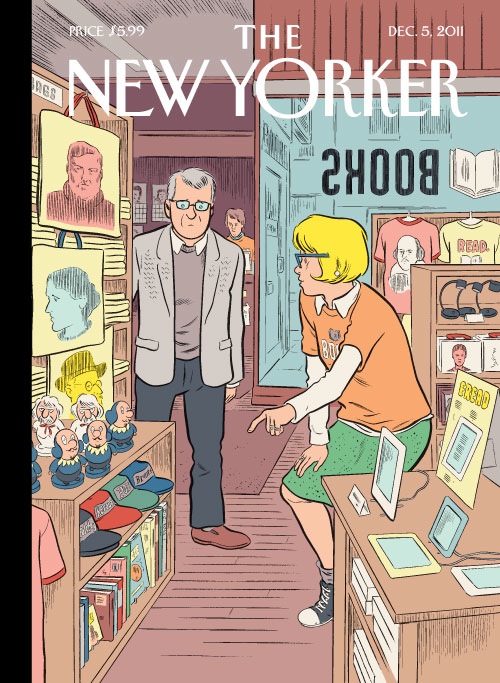
Daniel Clowes' cover for the New Yorker


"Where are the books?"
"Um, they're over here on the bottom shelf. But wouldn't you rather have a Simpsons themed Monopoly board? Or perhaps you'd like to browse our 32 different varieties of moleskine notebooks?"

So many bookstores (and online book retailers) have become like pharmacies; barely even carrying the things they were created to sell. My local CVS (aka Snuggie Outlet) doesn't carry Tylenol. The biggest pharmacy in town doesn't have Tylenol. TYLENOL. My god but they have waffle irons.

A book — a real book — is one choice, taken from a pile, opened and entered as its own singular, separate world. Once chosen, you are not holding the constant opportunity to alter or improve your choice, or simply change it just for the sake of restless change. You are there, now, without the relentless pressure of the fact that you could always be, and maybe you should be, maybe you’d be happier or more productive or different, doing something else.
KJ Dellatonia, Link

Imagine the least funny joke you can imagine and then imagine having to see that joke repeated for a hundred minutes while someone punches you in the face with the sharpest knife in the world while also pouring gasoline into the cuts and occasionally burning you with white hot fire. That’s a moderate approximation of the experience of watching this movie.
Roxane Gay on watching Jack and Jill, Link

It's also the experience of watching Carlos Mencia try to perform comedy. OHHHHHHHHHHHHHH. Snap.

Nothing will trickle down to you unless you shake the clouds. Time to make it rain updwards.
Jim Behrle on occupying American poetry, Link

I think mostly what this is about, is whether you’re the type of person who writes something on the Internet and feels secure/smug/confident or the type who is immediately racked with regret and self-doubt and self-loathing...

But there is that compulsion to say something. (Dare I say?) to say anything.
Elizabeth Ellen, Link

I'm that second type of person. Whenever I get a comment, facebook like, retweet, etc., evidence that whatever bullshit I've been spewing forth has actually been read, I become a nervous wreck. Whenever I comment on message boards or other people's blogs, I immediately close out of the window and log out of email, terrified of any response back. Or no response at all. It's complicated.

Hi! I have social anxiety disorder. Even on the internet! (fun!)

There's a list of the 56 Best/Worst Similes in this blog post from House of Figs. Whether they're the best or worst is up to you. But they're all hilarious. Here's a sample:
5. John and Mary had never met. They were like two hummingbirds who had also never met.

16. Long separated by cruel fate, the star-crossed lovers raced across the grassy field toward each other like two freight trains, one having left Cleveland at 6:36 p.m. traveling at 55 mph, the other from Topeka at 4:19 p.m. at a speed of 35 mph.

17. Shots rang out, as shots are wont to do.

43. The knife was as sharp as the tone used by Rep. Sheila Jackson Lee (D-Tex.) in her first several points of parliamentary procedure made to Rep. Henry Hyde (R-Ill.) in the House Judiciary Committee hearings on the impeachment of President William Jefferson Clinton.

And my all time fave:
51. It came down the stairs looking very much like something no one had ever seen before.

That sentence is so intriguing! What is "it," and what could it possibly look like? My mind goes immediately to Duchamp's Nude Descending a Staircase, but I've seen it before, so it obviously cannot look like that. The mystery!

I feel like I've used too many exclamation points today.


:(

Whatever. I'm just gonna watch this 50 times over and then play some Simpsons Monopoly.

Monday, December 5, 2011

why blogspot is a gigantic fart

I was almost finished with this nice, longish post on Lydia Davis and one of her short story collections, but I tried to undo posting a picture I realized was stupid, and somehow everything was deleted when I clicked the undo button, and clicking redo did nothing, and then blogspot autosaved like an ass, I lost everything, and now I feel like Jo March and Amy has burned my manuscript.

Dear blogspot: if you fall through the ice I'm not going to come save you.