Google+

Tuesday, April 2, 2013

Internet Lovelies

With the lone exception of George Clooney, no one in America ever comes out and says that not everyone wants to get married. The social compact, as expressed in political platforms, revolves around marriage and family life. The acceptance speeches at both of last summer's presidential-nominating conventions were addressed to only two demographic groups: "working families" and "families who work." That's fine, working families need the lion's share of social programs--the housing, the schools, the health care, the roads to get from the housing to the schools and the health care. But what about a shout-out to those of us single professionals who shell out gazillions of dollars in taxes to educate and care for all the working families' progeny?
Sarah Vowell, Link

Being a single, working tax payer is one of the most socialist things you can be. Add to that having a job providing free books to the public and my faded Communist Party tee (featuring Karl Marx with a lamp shade on his head and martini in hand) is looking more and more appropriate. 

I was able to meet Sarah Vowell last week, which was a pretty big highlight in what has been an overwhelmingly lightless winter. February and March can go straight to hell. Sarah is one of my favorite writers. I've read all six of her books, a read-count only surpassed by JK Rowling in terms of author loyalty (though that's more to do with addictive tales of child wizardry). She made an appearance at my alma mater, where she read from her most recent book, Unfamiliar Fishes. I was hoping she'd mention something about her next project, but she told the audience she wasn't ready to discuss it publicly. However she did read from something new, discussing the diaries of a grumpy cartographer who helped map the newly expanded western United States. It was absolutely hilarious, and I'm hoping it's a hint at what her next work will be. Books about cartography and map obsession are pretty big right now, with last year's publication of Ken Jennings' Maphead and Simon Garfield's On the Map. I'm not mapped-out yet, so bring it on.

Question: when you meet an artist, writer, musician, etc., you admire, what are you supposed to say to them? Other than blurting out something along the lines of I LIKE HOW YOU PUT WORDS TOGETHER. Or THE NOTES YOU PLAY SOUND GOOD. Because I'm lost when it comes to proper creator-fandom etiquette. They're just human beings, after all. Human beings who've heard from a thousand other nerds that they enjoy the things they've created. If you have legitimate questions, maybe that's different.

I remember several years ago when I went to a Rob Zombie concert (this librarian used to be pretty metal, albeit not with the best taste), my friend and I payed major dough so we could be the first ones let into the pit, to secure the coveted first "row," center stage. We did, along with about 50 others, and were so early that the band was still on stage doing sound check. There they were, and there we were, 10 feet away, in broad daylight and silence, and all 50 of us had no idea what we were supposed to do. There was a lot of feet-shuffling and checking of watches. Then two hours later when they took the stage, we all screamed our heads off because they were actually performing. Meeting artists when they're human, outside of the music, books, paintings or films in which they usually reside, just seems so awkward and surreal. Like you've suddenly been confronted with the fact that you're actually a stalker. A creepy stalker who's been paying for years to gain access to their inner-thoughts and emotions through the fourth wall of artistic creation.

Or maybe I'm over-analyzing this, and should just stand in line to get my book signed like everybody else.


Here are some more internet lovelies.

I don’t know about you, but any given week, I associate with, hang out with, deal with, talk with, laugh with, put up with, experience life with people who are gay, straight, bi-, brown, white, black, male, female, trans-, old, young, comfortably well off or strugglingly poor, and every mix and match possible. We are real people and we have real issues. Our lives are just as complicated as anyone else’s and just as ripe for storytelling as anyone’s.

The books I read growing up, the role model my uncle became, my own experiences and those of the people I loved, all of these conspired to make me hungry for stories, and I don’t want to be meeting the watered down worlds that don’t include facets of people that I know exist.
 Karina Cooper, Link 

Last year, when I was 33, people kept mentioning that it was my "Jesus year," the age Jesus was when he died. As in, I guess, if I hadn't saved mankind by the time I was 34, I could pretty much be counted as a failure. I'm much more concerned about my "Byron year" of 36. As in, if I haven't committed incestuous acts, gone to war, scandalized an entire nation, driven past lovers insane with jealousy, and written a few half-good manuscripts, then what the hell am I even doing with my life?
Jessa Crispin, Link

We played things on vinyl, because we were 22 and thought we were the first people to appreciate a variety of things, including wooden floors and theories of translation and our old telephone. Our landlord from upstairs would ring the phone at unsociable hours because all hours were unsociable and speak Quebecois French that I brain-translated into my-French then brain-translated into English and I have no idea what it meant but I think it meant, “Are you cold?” We called into work or university sick or university or work called into us sick — let’s just not move, either way. We made a lot of fried eggs and took it in turns to moonwalk out to the dépanneur two blocks away for cigarettes. I wore my yellow knitted socks and my pink silk dress and my grey woollen jumper and had my first encounter with the brain-dentistry of clinical depression. Once we didn’t leave the apartment for three days. The experience snowily, sleepily dusted all surfaces of human interactions — at breakfast: “We haven’t left the apartment for a week!” This was conversational exaggeration and at the same time possibly true.
Heather McRobie, Link 

That whole essay is wonderful. Check it out.

The division V.P. offered me a job after my two-week gig, which I cordially declined. I imagined myself waking up before dawn, raking bristles across my teeth, and taking the train eastward towards a spoiled sun which believes it is the center of our universe. We tell it stories of other stars, and it spits flames. Every downtown is a Jenga game about to end. Part of me wonders, regrets, what I would have become had I repeated yes like Molly Bloom. I will admit this world makes me, sometimes, want to put a rat inside someone’s asshole and record the contortions of their face simply out of aesthetic curiosity. Fortunately there is the internet, where I spend my time refreshing. The office was on the 36th floor, its spotless floor-to-ceiling windows pretending not to exist. I saw myself calmly walking to the edge and jumping off, my shadow morphing into the exact shape of my body the moment before the moment. “Sorry, waking up would be too much,” I say, unaware of the ontological metaphor. I exit his office in silent Cole Haan loafers.
Jimmy Chen, Link
 
Taken out of context the rat statement may not make sense in the passage above, but it's a reference to American Psycho. Click the link to read the entire essay. Or just go ahead and read everything Jimmy Chen's ever written, actually. I like the way you put words together, Jimmy Chen.

Wednesday, March 27, 2013

Balloon Pop Outlaw Black

Patricia Lockwood's poetry collection Balloon Pop Outlaw Black from Octopus Books feels like the most unified anthology of poems I've read in awhile. It's a collection in the true sense of the word.

Inside this book cartoons are words. And words are objects -- personified and three-dimensional. The first third of the collection is about the word "popeye," as you may be able to tell from Lisa Hanawalt's amazing cover art. And a recurring theme is the physicality of words themselves.

Example:

From "The Church of the Open Crayon Box"

Fat geese fly in any letter you like but you need
red meat for once, and write a splayed-hide word
like "Deerslayer," and take hold of the ending
                                          and drag it home,                                            

and

From "The Father of the Fictional Alphabet"

The letters must be forged--the father of the fictional alphabet
wears protective glasses, and holds flat and round sounds
in the roaring fire and uses a seashell for flux, and then drops
each letter in a bowl of cool water, and they steam in the shape
              of themselves, and the father of the fictional alphabet
rivets them to the machine: on all sides, in brass letters, it says:

              and it belches black smoke and itself,
and white mice run in wheels inside it, a clearie marble
rolls down a track, and here is a slot for quarters where
you buy a chgnk chgnk sound. The letters have whirligigs
in them, the letters release hundreds of helicopters, the letters
have snakes that slip between stones, the letters grow parrot-
head flowers, and the letters are bodies settled with blackflies.

I'm absolutely in love with the poem "Good Climbing Trees Grow Us", which I couldn't pick just part of to share. So do yourself a favor and buy the book, or check it out in issue 11 of MAKE.

But here are some other passages I loved:

From "When We Move Away From Here, You'll See a Clean Square of Paper Where His Picture Hung"

After supper, he sits on the porch with a
long black shotgun and waits for a
buffalo to wander into view. He uses
every part of the buffalo--he uses them
down to their eye whites, he uses the
very lines that make them up.

He walks to the city to be counted in
the census. A wind gets itself up and
ruffles him relentlessly, but miniature
monuments hold him down.

His paper is usually stacked neatly,
especially when still in original trees.

Lives where? In voices: hills and valleys. Lives
all in the alphabet as if it were a rowhouse.
Lives at the peak of the tallest chalk hill.

Or lives: nowhere at all. He wanders the desert,
written on old skins, moaning,
"Where is home, where is home?" And
waits for a tent peg to be driven
through his skull.

From "The Cartoon's Mother Builds a House in Hammerspace"

She moves as smoothly as the moment of a mousetrap, and
when her cartoon needs a mousetrap she gives one to him.

Even the act of extending an arm toward him produces a trombone.

And as she watches herself extend an arm, a collapsible
spyglass leaps out of her eye.

When she tiptoes across the lawn, so does a small green rose bush.

When a wrecking ball swings out of nowhere, she is riding it;
she makes a round cutout in the enemy's house and then
rides the cutout home.

Imagine her body as a barrel of gunpowder, uncorked,
spilling black along the ground behind it.

When she spreads her arms and sinks down, she brings a
detonator into the world.


87 pages
3,529 / 20,000 page goal

Monday, March 4, 2013

Guest Post: Review of 'Burning the Furniture'

My good friend Dusty from the blog Dusty On Movies was kind enough to share his review of Dan Smith's memoir Burning the Furniture with me. So put down Justin Bieber's latest book and read about someone who's had actual human experiences.


Everyone has an interesting life story. If you really get to know someone you'll find they have a fascinating history regardless of class or race. Not everyone, however, is fit to write a memoir. A good memoir requires a writer with both talent and courage. "Burning The Furniture" shows that Dan Smith has both in spades.

Dan has been writing and editing various local newspapers and journals for a long time. Currently he's the editor for Valley Business FRONT Magazine and offers some personal thoughts and opinions on his blog. He's also responsible for putting together the annual Roanoke Regional Writer's Conference, which sold out this year. My interest in local writing and journalism steered me towards Dan's writing, especially his blog where we could argue and debate all sorts of things.

It was probably the numerous blog visits that led Amazon.com to list "Burning The Furniture" in my suggested reading. Everyone knows that Amazon and Google keep close watch over where we visit so they can pester us with ads more accurately. In this case they did a good job. I bought the memoir for $3.99 in Kindle format and let Dan know about the purchase. He was happy to hear I was reading it, but shocked to find out it was now an ebook since he hadn't been notified of its conversion.

Prejudice is so easily formed. I had all sorts of notions about Dan's background and upbringing with zero facts supporting them. It turns out that his story was much deeper than I could have ever expected.

Dan's story starts out with poverty. He had seven siblings, an alcoholic father who died when Dan was 13, and a mother who suffered from depression and agoraphobia. His mother often couldn't pay rent and was always ready to move as eviction drew near. Growing up as a carny would probably have required less moving.
 
I was particularly moved by Dan's account of taking his black friends to a public swimming pool. At that time and place it was simply unheard of. When they arrived the local swimmers assaulted Dan and his friends with rocks. Dan was appalled. His friends weren't surprised. He found a sheriff by the side of the road and reported the incident. He got this response:

“Let me tell you boys something,” he said as level serious as he could get. “We don’t take to white people and niggers mixing here in McDowell County and we don’t take to niggers swimming in our water. You’uns is lucky you didn’t get killed back there and if you stay around here much longer or even think about coming back, that just might happen. Now you nigger-lovin’ trash just git on out of here.”

And Dan's reaction:

I don’t remember ever before or after being as angry as I was at that moment. My face felt hot and my body shook with rage. I glared at that tall, thin, red-haired trooper with the Smoky the Bear hat, knowing that if I lost my temper we would all suffer a lot more than we had. Coot reached over and put his hand on my arm. I slammed the gearshift lever into drive and threw gravel behind us as we sped away. “Goddammit!” I screamed. “What kind of country is this? Who the hell are these people?” I pounded on the steering wheel, even as I floored the accelerator.

For sure, things have gotten better since then. Still, I find myself reacting this way far too often in today's society.

As the story continues, Dan's courage reveals itself even more. The mistakes of childhood can easily be recalled then brushed off as a youthful indiscretion. To write about your struggles in adulthood takes a lot more gumption. Dan attacks his struggles head on: alcoholism, failed marriages, fatherhood regrets, lost jobs. He leaves no stone unturned. This also becomes a source of inspiration because he sobered up, has a career, and has a good relationship with his kids and grand kids. Everyone faces adversity and makes mistakes, but not everyone has the character to face that adversity and learn from their mistakes. Even fewer have the ability to write about it eloquently. Dan Smith is one of those few.

Memoirs are mostly successful based on the name value of their authors and not their inherent quality. Personally, I'd rather read a great memoir from a local author than some ghost-written fluff piece from a celebrity. I'm sure Arnold Schwarzenegger's memoirs will always outsell Dan Smith's, and that's a damn shame. "Burning The Furniture" is short, but satisfying. You won't regret investing your time in this one.
 

Cookbook Margin: Boeuf Démodé

Alternate titles:

Vegetable Margin
Virtual Margarine
It's My Blog and I Can Cook if I Want To

I have a pretty decent cookbook collection. It's not huge, but that's only because I've resolved to actually cook from the ones I own instead of succumbing to the temptation of buying more. And how tempting they are. I'm a sucker for heavy hardcovers; 300+ glossy pages of food porn, full of hard-to-pronounce dishes with obscure ingredients you're embarrassed to ask about in the grocery store ("excuse me, I totally know what a kumquat is, but...where are they and what do they look like?").

So if I'm going to cook my way through my cookbooks (so I can then buy more, a continuous loop of samsara), I may as well blog about it. Cookbooks are books too! And finding good ones can be a challenge. You never know how a recipe is going to turn out until after you've paid $30 for the ingredients and dirtied an entire sink full of dishes.

First up is a dish from Dorie Greenspan's Around My French Table, which I bought over 2 years ago after reading about it at Bookslut. I made the very first recipe, for gougères, which turned out beautifully. The cookbook itself is gorgeous, with big glossy pictures that make you feel like you're in the kitchen of a French country villa, and not in your shitty apartment surrounded by empty Lean Cuisine containers. Every recipe is described in detail, with extra info about the dish's background in French cuisine, which is really interesting. You can tell Greenspan has thorough knowledge of every dish, and feel like you can trust her completely. But even so, I didn't break open the cookbook again until yesterday.

Emily Dickinson wrote "Tell all the truth but tell it slant," which I'd like to revise to "Cook the recipe, but cook it slant." I don't think I've ever followed a recipe 100% as written. I always change things around, which can occasionally cause kitchen catastrophes. But it's how my mom cooks and how my grandmother cooked, and they're the best ones I've ever known. So every recipe I share will be my version of it. Then I highly recommend you check out the original recipes from the books themselves.


Boeuf Démodé 
my version of Boeuf à la Mode from Around My French Table by Dorie Greenspan

  • 2 lbs chuck, round or rump roast, cubed into 1 inch pieces
  • 1/2 large white onion, cut into large slices
  • 1 carrot, cut into chunks
  • 2 celery stalks, cut into chunks (save the leaves)
  • A bouquet garni -- 2 thyme sprigs, 2 parsley sprigs, and the leaves from the celery stalks, tied together with string, or in a piece of dampened cheesecloth
  • 1 750-ml bottle of red wine
  • 2 tbsp olive oil
  • 2 cups beef broth
  • 2 anchovies, drained, rinsed and patted dry
  • 1 tbsp tomato paste
  • 1/3 cup all-purpose flour

Be prepared: The beef must be marinated overnight, and will require a Dutch oven or covered casserole dish.

Put the beef into a tupperware container, bowl, or sturdy ziploc bag that can hold it, the vegetables, and the wine. Sprinkle with salt and pepper. Toss in the onion, carrot, celery, and bouquet garni and1 tbsp of the olive oil. Pour in the wine until the contents is covered (save yourself a glassful of the wine if possible -- you're done for the night). Cover the container or seal the bag and put in fridge to marinate overnight.

The next day, strain the container over a bowl, reserving the liquid. Remove the beef from the vegetables and place on paper towels. Set aside vegetables and bouquet garni. Pour the liquid into a medium saucepan and bring to a boil over high heat until reduced by half, about 10 minutes. Add the beef broth and bring back to a boil, then remove from heat.

Center a rack in the oven and preheat to 350 degrees F. Have the Dutch oven or casserole with a cover at the ready.

Pat the beef dry using paper towels. Put a skillet over medium-high heat and pour in the last tbsp of olive oil. Working with a few pieces at a time, sear the cubes of beef on all sides, just enough to brown them and form a light crust. Transfer the beef to the Dutch oven.

Return the skillet to medium heat and toss in the drained vegetables. Cook, stirring, until the vegetables are softened and browned, about 10-15 minutes. Transfer the vegetables to the Dutch oven.

Once again put the skillet over medium heat. Pour in 1/2 cup of the wine-broth mixture and stir in the anchovies and tomato paste. Cook, stirring, until the anchovies break up and "melt," a matter of minutes. Pour in the rest of the wine-broth mixture and stir to blend, then toss in the reserved bouquet garni. Pour the contents into the Dutch oven.

Put the Dutch oven over medium-high heat, and when the liquid comes to a boil, cover the pot tightly with a piece of aluminum foil and the lid. Slide the beef into the oven and cook undisturbed for 1 hour.

Pull the pot out of the oven, and remove the lid and foil. Using a large spoon or ladle, remove approximately 1 cup of the broth and put into a medium bowl. Gradually add the flour, while whisking vigorously. Continue whisking until there are no clumps. Season to taste with salt and black pepper, and pour back into the pot. Taste the sauce again, and repeat the process if needed, adding more flour if too thin or salt and pepper if bland. Return the pot to the oven for another 30 minutes.

Remove from the oven and serve immediately, or store for a day or two covered in the fridge, which will only enhance the flavor.


Behold! The only cute bowl I own.


Feeling completely guilty for making such a carnivorous recipe, I also decided to make one from the cookbook Vegan Cupcakes Take Over the World; I'm sure completely bewildering the guy bagging my groceries. It was supposed to be Vegan Coconut-Chai Cake, a version of Vegan Chai Latte Cupcakes with Vegan Buttercream Frosting from the book. It turned out horrifically, which I'm not sure is more attributable to the changes I made (pretty much just using a different kind of tea and making cake instead of cupcakes), or the fact that "Vegan" and "Buttercream" should never ever appear side-by-side in a sentence.

But it's okay. Now I'll be able to trade it in for a shiny new cookbook I can drool over.

Tuesday, February 26, 2013

Internet Lovelies


Consider that this happened in an evening when the Oscar host Seth MacFarlane cracked a gag that cast George Clooney as Humbert to Wallis's unwitting Lolita, and it starts to look less like a baffling lapse, and more like frat Hollywood asserting itself over a small black girl. You can act, the jokes imply; you can even be brilliant (as Wallis is in Beasts of the Southern Wild); you can be as cute as you like in your beautiful dress and your puppy-dog handbag, and we the Hollywood fraternity reserve the right to remind you that you are nothing but female, heading for a future where, six years from now, paps aim a long lens up your skirt and everyone calls you a slut because you didn't take the precaution of binding your legs together before getting out of a car.
Sarah Ditum, in reply to a tweet from The Onion about Quvenzhané Wallis, Link

We got the joke. And understand the satire. It was just straight up the wrong word to use. And MacFarlane's Wallis/Clooney "joke" was downright disturbing.

Can't you take a joke? Yes, I can take a joke. I can take a bunch! A thousand, 10,000, maybe even more! But after 30 or so years, this stuff doesn't feel like joking. It's dehumanizing and humiliating, and as if every single one of those jokes is an ostensibly gentler way of saying, "I don't think you belong here." All those little instances add up, grain of sand by grain of sand until I'm stranded in a desert of every "tits or GTFO" joke I've ever tried to ignore.
Margaret Lyons, Link

Etc.

I assume, if you're reading this, that you are most likely a human being with eyeballs in a head on top of a torso with nipples on it sitting on a butt attached to some genitals and legs and feet. Or some approximation thereof, give or take a few limbs/eyeballs/genitals as needed. In that case, congratulations! You have a body. And your body is—truth!—naked under your clothes right now. Look to your left. Look to your right. Literally 100% of the people within your line of sight are also naked under their clothes! And if, for some reason, some of those clothes happened to come off, or go invisible, or get burned off by acid rain or the erotic ray-gun of a lecherous sex-doctor, you might accidentally behold your neighbors' nakedness. And do you know what would happen then? Literally nothing. Nothing would happen to anyone.
Lindy West, Link

Well, not nothing. But nothing harmful, at least.

One of the most erotic experiences of my life remains book-sniffing, in a Bangkok hotel room, by myself, the Dutch translation of Crime and Punishment while rolling around on a bed of loose pages from Gravity’s Rainbow.
Teddy Wayne, Link


In this book there is a whale and some men…I will not give away any names.
Lincoln Michel, from a book report constructed of sentences in negative Amazon reviews of Moby Dick, Link 

Read that whole thing, because it's hilarious.

The IKEA “Lack” side table is $9.99 if you want it in “birch finish,” and $7.99 in plain white, a color which — when not imbued with high modernist sheen — concedes to a post-industrial grim boredom, even guilt, that is always trying to find its way back into the woods. This may be Walt Whitman’s fault, who saw a “journey work of the stars” in a blade of grass, so I have him to blame for my meandering horoscope.
Jimmy Chen, Link


The problem with Sephora... is that, like many drugs, too much is never enough. Sephora is a smoke monster, a rainbow, a Mobius strip of promises. There's no getting a grip on it. There is no end. There's only more. You can chase the dragon of self-improvement slash self-enhancement slash self-acceptance until the day you die; there's always a new fragrance, a new lip color, a new miracle cream right around the corner. Sucking your bank account dry. You go in for a lip balm and come out with body polish, dry shampoo, BB cream, and Kat Von D's "Sinner" smoky eyes palette...Oodles on display, a myriad of options, infinite possibilities. When you think you've finally found the solution, the crutch, the key, either you run out and need more; they stop making it and it vanishes like so much sparkly Guerlain Terra Cotta dust; or you find that what once satisfied you no longer does the trick. A deliciously sticky honey trap, from which you never fully escape; you leave, but the pull is strong, keeping you coming back.

Fucking Sephora, man.
Dodai Stewart, Link

Sephora, a.k.a. the reason I have nine different kinds of facial moisturizer in my bathroom right now, and nine dollars in my bank account.

Let Jenna Marbles explain to you this phenomenon of "goo hoarding":


Criticisms about representations of gender (or race and other diversity) are often countered in fandom by sociological or scientific analyses attempting to explain why the inequality happens according to the internal logic of the fictional world. As though there is any real reason that anything happens in a story except that someone chose to write it that way.

Fiction is not Darwinian: It contains no impartial process of evolution that dispassionately produces the events of a fictional universe. Fiction is miraculously, fundamentally Creationist. When we make worlds, we become gods. And gods are responsible for the things they create, particularly when they create them in their own image.
Laura Hudson, Link

Every word that has ever been put to paper (or screen) is the product of some bored human writing it. I hate when people treat fictional universes like some magical reality separate from the mind of the person who created them. If a made-up world contains profound sexism, racism, homophobia, class discrimination, etc., it's either to explore said concept in regard to its existence in the real world, or it's just thrown in because the writer can't imagine a world that doesn't contain those things. Which is unfortunate and really sad.

Here's an adorable video to cheer up your dreary Tuesday.


Thursday, February 21, 2013

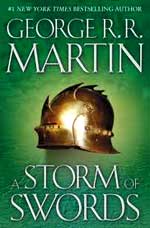
A Storm of Swords

I almost quit reading this one about halfway through, after a certain main character was presumably killed off. But I persevered, and on the last page we discover that this certain character is not dead, and a certain me ecstatically pumped her fists in the air.

Hopefully that was vague enough not to qualify as a spoiler.

I'm running out of things to say about this series. And I still have two books left! It kind of feels like everything is happening in slow-mo. I've been waiting something like 2500 pages for at least part of the Stark family to be reunited, and I'm afraid by the end of A Dance with Dragons we still won't get there. And if not...


As much as I love the world and the characters George R.R. Martin has created, I feel he could have done a much better job of introducing all those damn characters to us. J.K. Rowling's Harry Potter universe had tons of characters too, but I don't think at any point I ever had to stop and go "wait, who's that again?" Maybe it was all the alliterative and/or mythical names (Remus Lupin is a werewolf. Got it.), but moreso I think Rowling just knew how to ease readers into an unfamiliar world. In contrast, so far in A Song of Ice and Fire there's something like 4 different Brandons, a handful of Theons, and every character has something like 20 different names for themselves (Arya Stark, aka Arry, aka Weasel, aka Nan, aka Squab, aka Salty...). It's difficult to keep up.

And this is how A Feast of Crows starts out:

Dragons," said Mollander. He snatched a withered apple off the ground and tossed it hand to hand.
"Throw the apple," urged Alleras the Sphinx. He slipped an arrow from his quiver and nocked it to his bowstring.
"I should like to see a dragon." Roone was the youngest of them, a chunky boy still two years shy of manhood. "I should like that very much."
And I should like to sleep with Rosey's arms around me, Pate thought.

Hooray! Eight sentences in and we've already got FIVE brand new characters thrown at us! And by the end of the chapter the only one that has anything important happen to them is Pate (pro reading tip: anyone with a super boring name will be the first to die).

Drowning in exposition and family trees I may be, but I keep coming back for more. It's a ridiculously addictive series. And I'm trying to barrel my way through it as quickly as possible before I fall fate to any spoilers. If anybody tells me that Daeneyrs kills Dumbledore, so help me...

For those who have read the first two books/ watched the first two seasons of A Game of Thrones, you should check out this great review by Comicbookgirl19, comparing the books and the TV show:


1216 pages
3,442 / 20,000 page goal

Friday, February 8, 2013

A Clash of Kings

Between watching and rereading The Hobbit, playing Skyrim, and reading the A Song of Ice and Fire series, I'm feeling the urgent need to purchase a longsword and some chainmail.

After reading A Clash of Kings I'm officially hooked, and subscribed to HBO just to watch Game of Thrones (third season premiering in March!). Speaking of the series, has any other television show been more beautifully shot and well-cast? It's blowing me away. The screenwriting isn't exactly subtle (if I hear one more person ominously say "the dragons are all gone..."), but is still loads better than what's in the majority of feature-length films these days.

A serious hats off to George R.R. Martin for creating so many damn characters, cities, and mythologies, and being able to keep them all straight while writing. No seriously, there's a reason the book starts with two maps and ends with a FORTY PAGE LIST OF CHARACTERS. Good lord.

My favorite aspect of the series thus far is that all of the chapters come from the point of view of characters that are in some way powerless or disenfranchised. The social hierarchy for whatever reason has deemed them unfit, and they must fight to survive. That doesn't always mean they're sympathetic or likeable -- after all, Theon Greyjoy is one of them (I wanted so bad to just skip his chapters).

However, I'm still cringing at every mention of rape. It's always thrown in so casually, on every other page. Because apparently in Westeros rape is on par with stubbing one's toe. It's mentioned a lot in Stieg Larsson's Millennium trilogy as well, but that's because it ties directly into the story. Here it's just happening because it can. Call it a realistic portrayal of the consequences of warfare all you want -- last time I checked this was a fantasy story with fucking dragons in it. The author can make it however he pleases.

But for every sexually violent or misogynistic act there's an awesome female character to make up for it. Arya, Brienne, Osha, Catelyn, Daenyrs, Sansa, Cersei...they're all three-dimensional and well-written. A fantasy series that passes the Bechdel test with flying colors! Something that even the Harry Potter series had difficulty with.

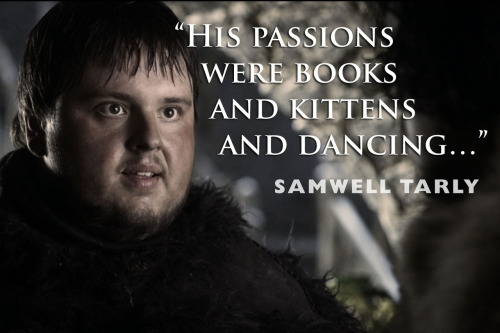
Whatever. I'm hooked. See you in April when I emerge from my winter cave, my eyes bleeding, mumbling about my crush on Samwell Tarly.

via http://red3blog.tumblr.com

As are mine, Samwell. As are mine.

1040 pages
2,226 / 20,000 page goal