Google+
Showing posts with label Carl Sagan. Show all posts

Friday, July 1, 2011

Contact, 29/100

At age twelve, I was completely obsessed with the 1997 film adaptation of Carl Sagan's novel Contact. It may have been what inspired my fanciful notions of growing up to be an astronaut. Then again, most films with interesting female leads at that time sent me into dreams of impossible vocations. After Twister I was absolutely going to be a storm chaser. Jurassic Park? Paleontologist. Tomb Raider? Well, a tomb raider I guess. But what do you major in in college to become a tornado chasing, tomb raiding, tyrannosaurus-rex tamer? It took me a long time to realize that what I loved was READING (and watching) about those things.

Then came the agony over deciding between a BA in English or Film. But that's another story.

THIS story is about a woman who is the first on Earth to contact intelligent life elsewhere in the galaxy. I'm willing to guess most people have seen the movie, so I won't spoil anything. I will say that the book is infinitely better than the film (no Forrest Gump-esque score or Matthew McConaughey, for one).

Carl Sagan was blessed with ridiculous talent. He had the super-intelligence to be a renowned astronomer, and the rare ability to translate that knowledge into accessible writing. Creative and non. And beyond that he was a promoter of peace and humanism. What I'm trying to say here is we should start The United Church of Carl Sagan.

Like all good science fiction, the plot may be out-of-this-world, but it's pointing directly back at the world. The story is about communicating with alien life, however it's more concerned with how humans communicate amongst themselves. The ultimate message is that we're not ready to talk to the gods until we're able to converse with each other on our own planet successfully. Peacefully.

Not many quotables, but I did like this observation:

Any faith that admires truth, that strives to know God, must be brave enough to accommodate the universe. I mean the real universe. All those light-years. All those worlds. I think of the scope of your universe, the opportunities it affords that Creator, and it takes my breath away. It's much better than bottling Him up in one small world. I never liked the idea of Earth as God's green footstool. It was too reassuring, like a children's story...like a tranquilizer. But your universe has room enough, and time enough, for the kind of God I believe in.

Monday, September 27, 2010

The Final Frontier


Most girls my age in 1995 probably had posters of Jonathon Taylor Thomas or Leonardo DiCaprio up on their bedroom doors. I had a NASA poster depicting the Andromeda galaxy. I've been fascinated by space for as long as I can remember. I wanted to be an astronaut when I grew up...alas, being decent at math seemed to be a pre-requisite (damn you, long division! You crushed my dreams!)

In fact, the only part about eventually kicking the bucket that really bothers me is knowing I won't live long enough to go into space. But who knows, maybe technology will be advanced enough in 2065 that they can launch my geriatric ass to Pluto if I so desire.

So of course, I loved reading Mary Roach's new book, Packing for Mars: The Curious Science of Life in the Void, which is all about the human side of space travel. And you won't believe all the problems the sheer factor of weightlessness presents. Figuring out how to eat sandwiches becomes a multi-million dollar ordeal. And as with any addictive non-fiction book, I came away with all these little interesting factoids that I've been showering on my annoyed friends and family for the past week.

Like, did you know that NASA briefly considered a one-way trip to the moon? As in, "we'll drop you off here, and then pick you up in a few years. Or whenever we actually develop the technology to launch a craft off the lunar surface..." (Side note: some astronauts have volunteered to travel to Mars without a trip home. Side side note: I would totally be willing to go on a suicide trip to Mars. NASA, call me!)

And, did you know that NASA did a series of "limited personal hygiene" tests before Gemini VII, wherein they locked people in a room wearing spacesuits for 2 weeks without allowing them to bathe? (Side note: NASA, I am NOT willing to do this). Gemini VII, if you don't recall, required 2 astronauts to sit in a capsule the size of the front seat of a VW Beetle for 2 weeks while orbiting the Earth. High price for the best view in the world.

Or, did you know NASA pays test subjects $17,000 to lie in bed for 3 months so they can study bone deterioration? If I ever get laid off...

But the entire book is fascinating and highly recommended. Here are some passages:

Quote from Ralph Harvey on giving a tour at NASA:
"I opened this one door and it was like the scene from Raiders of the Lost Ark. There were these rows of long, low freezers. They all had a little light on them that's blinking, and a temperature readout, and a piece of tape with the astronaut's name. I'm like, Shit, they stored the astronauts in here! and I quickly got the people out. I found out later that was there they stored the astronaut feces and urine." Harvey can't recall the room number. "You have to stumble onto it, that's the only way you can find it. It's like Narnia."


On the need to send actual humans to Mars:
We live in a culture in which, more and more, people live through simulations. We travel via satellite technology, we socialize on computers. You can tour the Sea of Tranquility on Google Moon and visit the Taj Mahal via Street View. ...But it isn't anything like reality. Ask an M.D. who spent a year dissecting a human form tendon by gland by nerve, whether learning anatomy on a computer simulation would be comparable. Ask an astronaut whether taking part in a space simulation is anything like being in space. What's different? Sweat, risk, uncertainty, inconvenience. But also, awe. Pride. Something ineffably splendid and stirring. ...

The nobility of the human spirit grows harder for me to believe in. War, zealotry, greed, malls, narcissim. I see a back-handed nobility in excessive, imptractical outlays of cash prompted by nothing loftier than a species joining hands and saying "I bet we can do this." Yes, the money could be better spent on Earth. But would it? Since when has money saved by government red-lining been spent on education and cancer research? It is always squandered. Let's squander some on Mars. Let's go out and play.


And:

Every now and then, you do come across astronauts who describe an anxiety unique to space. It's not fear...It's more of an intellectual freak-out, a cognitive overload. "The thought of one hundred trillion galaxies is so overwhelming," wrote astronaut Jerry Linenger, "that I try not to think about it before going to bed, because I become so excited or agitated or something that I cannot sleep with such an enormous size in my mind."...

Cosmonaut Vitaly Zholobov described looking at a star while on board the Soviet space station Salyut 5 and grasping in a sudden and visceral way that space is a "bottomless abyss," and that it would take thousands of years to travel to that star. "And that's not the end of our world. One can travel further and further and there is no limit to that journey. I was so shocked that I felt something crawling up my spine."


I feel the same way whenever I view Hubble's Ultra Deep Field image taken back in 2004. It was taken from a pixel in the sky, and it contains 10,000 galaxies. I think about that, and realize that nothing I do is all that important, or special. Which is actually pretty comforting. Maybe because I know there's nothing I could do that could screw up anything THAT badly. But it makes you realize how silly humanity can be. We put our priorities in the wrong things. Treat each other poorly. Put our faith in the material and petty, when it's obvious by this picture that your diamond ring, your manicured lawn, your hate, ideologies, cults, and wars mean nothing in the face of 100 trillion stars.

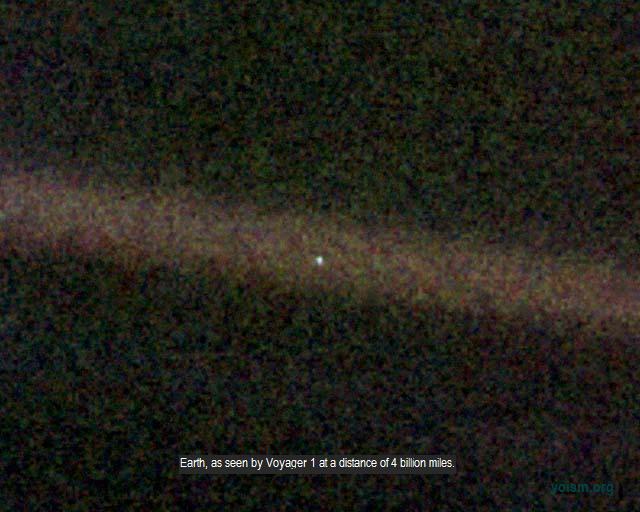
But Carl Sagan said it a lot better than I can. From his book Pale Blue Dot, he muses on a picture taken by Voyager 1 of the Earth from beyond the orbit of Pluto:


From this distant vantage point, the Earth might not seem of particular interest. But for us, it's different. Consider again that dot. That's here, that's home, that's us. On it everyone you love, everyone you know, everyone you ever heard of, every human being who ever was, lived out their lives. The aggregate of our joy and suffering, thousands of confident religions, ideologies, and economic doctrines, every hunter and forager, every hero and coward, every creator and destroyer of civilization, every king and peasant, every young couple in love, every mother and father, hopeful child, inventor and explorer, every teacher of morals, every corrupt politician, every "superstar," every "supreme leader," every saint and sinner in the history of our species lived there – on a mote of dust suspended in a sunbeam.
The Earth is a very small stage in a vast cosmic arena. Think of the rivers of blood spilled by all those generals and emperors so that, in glory and triumph, they could become the momentary masters of a fraction of a dot. Think of the endless cruelties visited by the inhabitants of one corner of this pixel on the scarcely distinguishable inhabitants of some other corner, how frequent their misunderstandings, how eager they are to kill one another, how fervent their hatreds.

Our posturings, our imagined self-importance, the delusion that we have some privileged position in the Universe, are challenged by this point of pale light. Our planet is a lonely speck in the great enveloping cosmic dark. In our obscurity, in all this vastness, there is no hint that help will come from elsewhere to save us from ourselves. ...

It has been said that astronomy is a humbling and character-building experience. There is perhaps no better demonstration of the folly of human conceits than this distant image of our tiny world. To me, it underscores our responsibility to deal more kindly with one another, and to preserve and cherish the pale blue dot, the only home we've ever known.


I think to say a picture speaks a thousand words is a vast understatement.