Google+
Showing posts with label Tao Lin. Show all posts

Thursday, November 3, 2011

Bed, 56/100

Advance apologies for all quotes below.

Sometimes I have a lot to say about a particular book, and sometimes I don't. I've never been very good at coming up with abstract reviews for things like poetry, short stories, conceptual novels -- anything without a big ol' plot. I can write about plot. But I can't write a review with phrases like "impressively smart" or "highly entertaining." Because that wouldn't tell you anything. I may just as well say "I liked it. It was good."

So trying to tell you why I liked Tao Lin's Bed would be like me trying to tell you why I like Seinfeld.

Seinfeld is a show about nothing.

Bed is a short story collection about:

College students, recent graduates, and their parents work at Denny's, volunteer at a public library in suburban Florida, attend satanic ska/punk concerts, eat Chinese food with the homeless of New York City, and got to the same Japanese restaurant in Manhattan three times in two sleepless days, all while yearning constantly for love, a better kind of love, or something better than love, things which--much like the Loch Ness Monster--they know probably do no exist, but are rumored to exist and therefore "good enough." [From the back cover]

And I liked it. It was good.

Bed has to be my favorite of Tao Lin's books. And it's probably the most accessible. Start with this one rather than Eeeee Eee Eeee. Work up to that one.

Here are some of my favorite passages:

Outside, crossing Fifth Avenue, he looked up at the buildings and felt a kind of rapture, something of apology and thanks and intelligence--though maybe just a thing of coffee and wakefulness--forming, like a good idea (the world thinking hard, finally), here, in the little wind, the slightly infrared space between the buildings, the wet, shucked gemstars of the traffic lights, and all the glassy windows above, bright and comprehending as eyes, watchful as a world that wanted, truly, to know--and to love--all its lost and bewildered people.

"And what's gravity? No one knows. No one cares. Why is there gravity? That's so weird. That's like, why are there things? That's so depressing, that that question even exists. But sincere, I think."

[Aaron] began writing sort of science-fiction conceits for workshop; crude, uncritiqueable things that did not fuck around, but got straigt to the point, which was always bafflement. In one, an alien civilization discovers that gravity is the cause of worry, love, and fear, the underlying desire of all things to occupy the same space (to correct the big bang, go against God's, or whoever's, big impulse move, that shady decision of somethingness) to again become one final, gravityless, unchangeable thing--and is baffled.

He thought it might make a good children's book one day, a collection of them "Fairy Tales for the Young Disillusionist", or something. "Handbook for Doomed and/or Disenchanted Children: a Pop-Up Collection".

As one had to expect very little--almost nothing--from life,...one had to be grateful, not always trying to seize the days, not like some maniac of living, but to give oneself up, be seized by the days, the months and years, be taken up in a froth of sun and moon, some pale and smoothie'd river-cloud of life, a long drawn-out and gray sort of enlightenment, so that when it was time to die, one did not scream swear words and knock things down, did not make a scene, but went easily, with understanding and tact, and quietly in a lightly pummeled way, having been consoled--having allowed to be consoled--by the soft and generous worthlessness of it all, having allowed to be massaged by the daily beating of life, instead of just beaten.

"Depressed people...are so depressed and harmless. Bin Laden and everyone, Bush--they're always grinning on TV. What the fuck is that. No on ever thinks about this shit, really."

First week of February you began to suspect that, for the rest of your life, nothing might happen. This was one of those years. You mail-ordered a special mattress, and napped too much. In restaurants, people ordered the ice-cream cake, shoved their hands under their thighs, and talked loudly about death. On TV, politicians began to snack from Ziploc bags, like a provocation. Almonds, raisins. Sour Patch Kids.

Things, you felt, had changed.

There was a new foreboding to the room in which you slept. There was the fear, now, that all your anxieties and disconsolations might keep on escalating and never stop. There was the theoretical chance that if you threw a banana at a wall the banana might go through the wall.

You were one person alive and your brain was encased inside a skull. There were other people out there. It took an effort to be connected. Some people were better at this than others. Some people were bad at it. Some people were so bad at it that they gave up.

Wednesday, June 8, 2011

Cognitive-Behavioral Therapy, and You Are a Little Bit Happier than I Am, 25-26/100


Here are some lines I enjoyed from Tao Lin's book of poetry, Cognitive-Behavioral Therapy, in order of pagination:

from "eleven page poem, page nine":
my unit of communication is the 200-page novel
always remember that i am better than you, according to me
small feelings of permanence later get wrapped and sold on amazon

from the untitled hamster poem on page 63:
'They found a slug in a tree and like 50 ants climbed on top of the slug to try to kill it but the slug jumped out of the tree to try to kill itself but it didn't die by falling and they attacked it more but the slug oozed this sticky mucus and the ants got caught in it and the small ants went and got soil and put it all over the slug and it soaked up the mucus and then sawed the slug's body apart with their pinchers and brought it back to the babies,' the hamster friend says.

The hamster tells its hamster friend that what it just typed is the name of their new press if they just add the word books at the end.

from "fourteen of twenty-four":
innate in all taco bell patrons is the possibility
of phenomenal poetry--something to look forward to

from "eighteen of twenty-four":
...to instill an awareness of death
directly into the reader's facial expression
is still one of the most powerful literary devices available
to distill the essence of any argument or rhetorical situation
pretend you are speaking from an enormous distance
and the audience doesn't exist
and you are not the person who is speaking

from "twenty-one of twenty-four":
one can claim ownership only of what exists within one's skin
and then maybe only what the brain can directly move the atoms of
from one's own perspective the brain seems to own itself
we observe the brain from an abstract distance
we observe each other from a physical distance
the brain observes nothing from no distance
therefore everything is going to be OK

Here are some lines I enjoyed from Tao Lin's book of poetry, You Are a Little Bit Happier Than I Am, in order of pagination:

from "spring break":
i lie on my bed and i wait for your phone call
the only person in the world that i like
my favorite person
not god but a person

and i know you can't save me, you didn't create the universe in seven days
you're just another person who isn't in love with me
but maybe you can do something, still, i guess ...

from "Appreciate Me For Everything Good I Have Done in the Past":
My demeanor in social situations
can be described as 'low-level panic attack.'

from "At That Leftover Crack Concert Two Years Before I Met You":
I think I would panic and drive into a building if I was in Manhattan and a fire truck had its sirens on. In Florida when I'm driving I always use ambulances as an excuse to make illegal U-turns and to drive over medians and do other fun and provocative things with my car. One time an ambulance was coming and I made a U-turn and saw a tree and calmly drove there and knocked it down then saw a shrub and went to that and ran it over like a lawn mower. I felt patriotic because I was trying harder than everyone else to get out of the way of the ambulance.

Tuesday, April 12, 2011

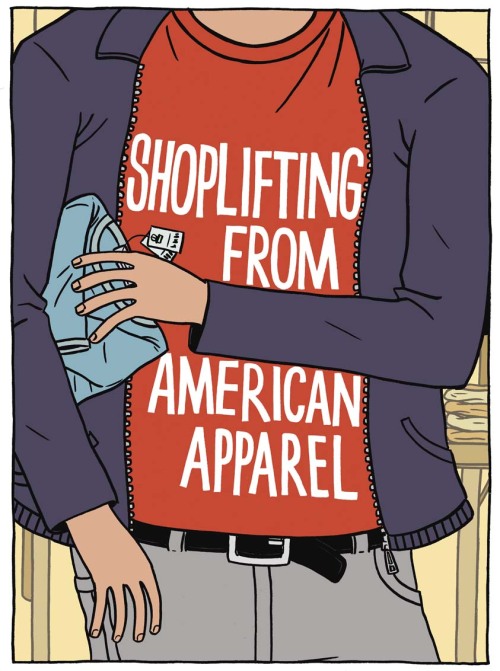
Shoplifting from American Apparel, 19/100


If someone came up to me and asked, "What author do you feel best represents the generation of people* born between 1983 and 1988?", I would answer, "Tao Lin."

*also suburban and/or middle class

Shoplifting from American Apparel has a loose plot, although it's not really important. Instead, the novella focuses on themes of alienation, boredom, and ineffective communication -- whether it's face-to-face or through g-mail chat.

Oh yes, the g-mail chats. Lin's work wouldn't be the same without them. In fact, his writing is saturated with social technology. Beyond just name-dropping Facebook, Myspace (this novella was published in 2009, but just this reference has already dated it), and Flickr, it's also feels electronic in other ways -- the short, Twitter-like descriptions, or showing emotion through "facial expressions", like emoticons.

But for the most part it's just funny. Hilarious. The kind of humor that anyone who has ever laughed watching "Two-and-a-Half Men" probably wouldn't find humorous. Which if you have, that's fine. To each his/her own. Just don't buy this book.

"You know those people that get up every day, and do things," said Luis.
"I'm going to eat cereal even though I'm not hungry," said Sam.
"And are real proactive," said Luis. "And like getting things done, and never quit their jobs. Those people suck."

"My face is going to float away from my skull," said Sam. "To emo music."

"Luis, what are we."
"Fucked," said Luis. "Was that like a cheer. What are we! Fucked. Our shit can be studied by an anthropologist 1,000 years from now to know what we ate."
"Indian food," said Sam.
"They will say 'Sam had a vegan diet of good food and wine and Indian food. Luis ingested Waffle House.'"

He lay on his mattress and thought about writing a novel about working hard and becoming rich and living alone in a giant house in Florida. Loneliness and depression would be defeated with a king-size bed, an expensive stereo system, a drum set, a bike, an unlimited supply of organic produce and coconuts, maybe calmly playing an online role-playing game. Each day the person in the novel would lay in sunlight on the living room carpet listening to music in "surround-sound" while drinking iced-coffee. At night the person would ride a bike around the neighborhood or drink smoothies while taking very long baths.

Someone on the street messed up a trick on their skateboard.
"You can't skate," should Audrey.
"What," said the person skating away.
Audrey shouted "Obama" at the person.
"That was good," said Sam. "You dominated him a lot."

Also, it turns out SFAA is being adapted into a film!


Brad Warner will be playing the part of Sam. I've read two of Warner's books: Hardcore Zen: Punk Rock, Monster Movies and the Truth about Reality, and Zen Wrapped in Karma Dipped in Chocolate: A Trip Through Death, Sex, Divorce, and Spiritual Celebrity in Search of the True Dharma (thank you, CTRL+C, CTRL+V). If those sound interesting, you should check out his blog: http://hardcorezen.blogspot.com/

Saturday, February 19, 2011

Eeeee Eee Eeee, 11/100

Let me begin by sharing the summary of Tao Lin's Eeeee Eee Eeee from the back cover:

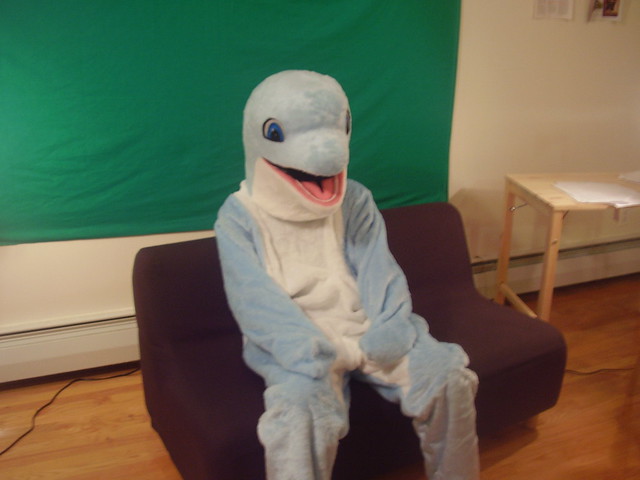
Confused yet intelligent animals attempt to interact with confused yet intelligent humans, resulting in the death of Elijah Wood, Salman Rushdie, and Wong Kar-Wai; the destruction of a Domino's Pizza delivery car in Orlando; and a vegan dinner at a sushi restaurant in Manhattan attended by a dolphin, a bear, a moose, an alien, three humans, and the President of the United States of America, who lectures on the arbitrary nature of consciousness, truth, and the universe before getting drunk and playing poker.

Well, yes, that is what happens.

Certainly Tao Lin isn't for everyone. But I love his writing. I have a feeling if I ever sat down to write, something like this book is probably what would come out. Not as well written. Not even as coherent. But similar. Perhaps.

Eeeee Eee Eeee (named after the sound dolphins make), is a mixture of the absurd and the philosophical. And it's hysterically funny. It's on different wavelength than Lin's Richard Yates.

Here are some passages.

What was Andrew doing the entire time in college? Everyone was constantly busy and partying, or attempting suicide. Andrew was always telling people he'd just slept fourteen hours.

They go to Wal-Mart. They look for something to use against the little sisters. Can't find anything. They stay at Wal-Mart over two hours. In the car Andrew has a videotape, Gosford Park.

"You son of a bitch," Steve says.

"Did you see this?"

"You son of a bitch," Steve says again.

Steve on a killing rampage; mass grave in the side yard. "It won every award," Andrew says. "Because the director is a hundred years old or something. It's the Jhumpa Lahiri of movies."

"Irony is so privileged," Mark said. "It's what happens when you don't need to do anything to survive--it's when the things you do have nothing to do with survival and you spend forty million dollars to make Steve Zissou and the Atomic Submarine or whatever it's called."

He sometimes felt that life was something that had already risen, and all this, the Jackson Pollack of spring, summer, and fall, the vague refrigeration and tinfoiled sky of wintertime, was just a falling, really, originward, in a kind of correction, as if by spiritual gravity, towards the wiser consciousness--or consciousnessless, maybe; could gravity trick itself like that?--of death. It was a kind of movement both very slow and very fast; there was both too much and not enough time to think.

Was this for real? Andrew had forgotten how to be happy! He suspected that it involved unwarranted feelings of fondness for other people, too much self-esteem, a sort of long-term delusion that manifested as charisma, and a blocking out of certain things, like lonely people, depressed people, desperate people, homeless people, people you've hurt, people you like who don't like you, politics, the nature of being and existence, the continent of Africa, the meat industry, McDonald's, MTV, Hollywood, and most or all of human history, especially anything having to do with the Western Hemisphere between 1400 and 1900, plus or minus 200 years--

How can you be angry at someone else's assumption or context that was as arbitrarily chosen or adopted as your own? If you unsarcastically feel anger at anything except everything it means your context does not include the information that assumptions have been made and contexts have been created;...any unsarcastic thought or action is a horrible distortion...There are assumptions and contexts and we go around pretending and playing games by overlapping our assumptions and contexts with others until there is no more time left.

Andrew is afraid of his neighbors. The gate has a secret pass code. Sara has a secret pass code. She should. Andrew would stand there for years trying combinations. He wouldn’t keep track or develop a strategy but just continue trying different combinations and then Kafka would rise from the grave and write a novel about him.

Saturday, October 23, 2010

Sad facial expression


Finally got around to reading Tao Lin. I've had Shoplifting from American Apparel on my wishlist forever, but Richard Yates became available as an e-book, which sealed the deal. Richard Yates is not about Richard Yates. Or it is. I haven't read anything by Richard Yates yet so I can’t tell. My eyes can only scan and interpret symbols on a page/computer screen so fast, and the entirety of human knowledge and literary creation is before me. So just...just hold on.

I felt a little like a stranger stumbling into his work. Because hey, I’m not a hipster, or vegan, and I’m not working on an MFA. I don’t belong here! But here I was, and by page 38 I had given up. I despised the main character to an enormous extent. Which sounds weird because it’s weird to hate Haley Joel Osment to an enormous extent. The plot, by the way, is about two depressed young adults, 22 year old 'Haley Joel Osment' and 16 year old 'Dakota Fanning', who Gchat and start a long distance relationship. By page 38 I hated the book. I hated the fact that it was an e-book and I couldn’t sell it to a used bookstore or throw it out the window. I considered printing out a copy and then throwing the copy out the window.

The next day I started reading again. It had affected me. Tao Lin’s prose is probably best described as ‘flat’ or neutral. In many ways it’s like reading a screenplay. Or maybe a twitter feed (especially since we're told every single thing the characters eat). And the dialogue is primarily conducted through e-mail and Gchat. Which, by the way, Tao Lin portrays perfectly. I read this part and was blown away by how much it resembled AIM conversations with my friends:

"When." said Haley Joel Osment.
"I don't know. Soon. I will talk to fried Nicholas Sparks cheese beast."
"That is good," said Jaley Joel Osment. "Cheese beast."
"I kept looking at 'cheese beast' and ignoring the rest."
"Me too," said Haley Joel Osment.
"Let's refer to her as cheese beast now," said Dakota Fanning. "Like tape man or headbutt girl."
"Sometimes we can call other people cheese beasts too," said Haley Joel Osment.
Dakota Fanning said the name of a person and said the person was a cheese beast.
"Cheese beast is good," said Haley Joel Osment.


But behind his 'flat' prose are highly emotional conflicts and characters. Haley and Dakota are the kind of people who proclaim everything to 'be fucked' at every opportunity. Who threaten suicide non-chalantly. The kind you roll your eyes at, but still worry over, and secretly sympathize with. Jackie Wang put it best in a post on HTMLGiant about emotional excess:

Since crossing over into my 20s, I look at teenagers and feel kind of embarrassed for them. They lack emotional filters. They’re so direct about their suffering. They’re making themselves look pathetic. But really–I kind of envy them, their lack of restraint. It must be really freeing to be that open without feeling the urge to censor yourself...

...we are still these over-feeling and fucked up human beings, and we have these little pimply and confused teenagers inside of us yelling and demanding a voice but we hush that voice–we have co-workers and editors and readers that are always eyeing us, looking for the places where the seams of the adult bodysuits are coming undone.


I love emotionally excessive lit, but mostly in the gothic genre. Characters in gothic plots have extreme emotions because they're thrown into extreme situations. Confronted with the surreal, the sublime, the supernatural, the walking dead, immortality, pure evil,...giant helmets... no wonder the characters break free of their enlightened restraint, succumbing to ultimate despair and fear, running screaming into the night. But it's so much more disturbing to come across characters who feel this way all on their own.

"A fucked person enters an unfucked situation, and the situation immediately becomes fucked. It's the person that is fucked," said Haley Joel Osment. "Obviously."

"Situations can't be fucked because they are situations," said Julia.

"We are profound." said Haley Joel Osment. "Where is our Nobel Prize."


I stopped reading because I hated Haley Joel Osment. I continued reading because I identified with him. I didn't like this. Haley is in a relationship with someone who he thinks doesn't care. Who says one thing and does another. Here are some things he says that I marked:

At each moment you can either kill yourself, try harder to detach yourself from people and reality, or be thinking of and doing what you can for the people you like. Those are the only 3 choices at any moment.


"You shouldn't 'should' anything," said Haley Joel Osment. "Just think about what you do that you do without thinking to do it, like stopping to pee, why do you want that more than what you say you actually want? It can only mean that you don't actually want what you just typed. You are extreme when you cut yourself or starve yourself but not when it comes to me."


He says what I've always wanted to say. And anyone who knows me well enough knows why. But it's a guilty thought. It's a selfish thing to feel. I feel like a selfish person asking someone else not to be so selfish. In another post by Jackie Wang on her own blog, she writes:

Sometimes, my partner is very far. I become totally unfamiliar to her: I turn into a weird alien sitting next to her that she knows nothing about. This upsets me a lot, because I feel like I am always present—I don’t have those moments where I doubt our love, or the reality of her. And sometimes when she gets hung up on a death-oriented discourse, I refuse to accept this. I say, you can’t “love” me while being obsessed with death. The film made her so upset because it showed her what it was like to be on the other side of the death discourse—to be the lover of someone who does not want to live. But I can understand her side as well because I get depressed too—we all are in the slumps sometimes. But even when I am in it, I want to get out. I reject it and refuse to integrate it as part of my identity because really, I want to live. And I want to want to live. To be in the world.


Which after reading I mouthed 'Yes,' feeling a moment of connectedness, realizing someone else has experienced what I've gone through.

There's a section of the book I really wanted to post here, to show you how well the author portrays an extremely emotional moment using neutral prose, causing it to have even more impact. But it's rather long and I don't feel like being sued today. Plus, I suppose it would be a spoiler. However, I want to say that I'm glad I finished the novel. Tao Lin's work is masterful, it just took me reading the entire thing to realize it.