Google+

Tuesday, February 26, 2013

Internet Lovelies


Consider that this happened in an evening when the Oscar host Seth MacFarlane cracked a gag that cast George Clooney as Humbert to Wallis's unwitting Lolita, and it starts to look less like a baffling lapse, and more like frat Hollywood asserting itself over a small black girl. You can act, the jokes imply; you can even be brilliant (as Wallis is in Beasts of the Southern Wild); you can be as cute as you like in your beautiful dress and your puppy-dog handbag, and we the Hollywood fraternity reserve the right to remind you that you are nothing but female, heading for a future where, six years from now, paps aim a long lens up your skirt and everyone calls you a slut because you didn't take the precaution of binding your legs together before getting out of a car.
Sarah Ditum, in reply to a tweet from The Onion about Quvenzhané Wallis, Link

We got the joke. And understand the satire. It was just straight up the wrong word to use. And MacFarlane's Wallis/Clooney "joke" was downright disturbing.

Can't you take a joke? Yes, I can take a joke. I can take a bunch! A thousand, 10,000, maybe even more! But after 30 or so years, this stuff doesn't feel like joking. It's dehumanizing and humiliating, and as if every single one of those jokes is an ostensibly gentler way of saying, "I don't think you belong here." All those little instances add up, grain of sand by grain of sand until I'm stranded in a desert of every "tits or GTFO" joke I've ever tried to ignore.
Margaret Lyons, Link

Etc.

I assume, if you're reading this, that you are most likely a human being with eyeballs in a head on top of a torso with nipples on it sitting on a butt attached to some genitals and legs and feet. Or some approximation thereof, give or take a few limbs/eyeballs/genitals as needed. In that case, congratulations! You have a body. And your body is—truth!—naked under your clothes right now. Look to your left. Look to your right. Literally 100% of the people within your line of sight are also naked under their clothes! And if, for some reason, some of those clothes happened to come off, or go invisible, or get burned off by acid rain or the erotic ray-gun of a lecherous sex-doctor, you might accidentally behold your neighbors' nakedness. And do you know what would happen then? Literally nothing. Nothing would happen to anyone.
Lindy West, Link

Well, not nothing. But nothing harmful, at least.

One of the most erotic experiences of my life remains book-sniffing, in a Bangkok hotel room, by myself, the Dutch translation of Crime and Punishment while rolling around on a bed of loose pages from Gravity’s Rainbow.
Teddy Wayne, Link


In this book there is a whale and some men…I will not give away any names.
Lincoln Michel, from a book report constructed of sentences in negative Amazon reviews of Moby Dick, Link 

Read that whole thing, because it's hilarious.

The IKEA “Lack” side table is $9.99 if you want it in “birch finish,” and $7.99 in plain white, a color which — when not imbued with high modernist sheen — concedes to a post-industrial grim boredom, even guilt, that is always trying to find its way back into the woods. This may be Walt Whitman’s fault, who saw a “journey work of the stars” in a blade of grass, so I have him to blame for my meandering horoscope.
Jimmy Chen, Link


The problem with Sephora... is that, like many drugs, too much is never enough. Sephora is a smoke monster, a rainbow, a Mobius strip of promises. There's no getting a grip on it. There is no end. There's only more. You can chase the dragon of self-improvement slash self-enhancement slash self-acceptance until the day you die; there's always a new fragrance, a new lip color, a new miracle cream right around the corner. Sucking your bank account dry. You go in for a lip balm and come out with body polish, dry shampoo, BB cream, and Kat Von D's "Sinner" smoky eyes palette...Oodles on display, a myriad of options, infinite possibilities. When you think you've finally found the solution, the crutch, the key, either you run out and need more; they stop making it and it vanishes like so much sparkly Guerlain Terra Cotta dust; or you find that what once satisfied you no longer does the trick. A deliciously sticky honey trap, from which you never fully escape; you leave, but the pull is strong, keeping you coming back.

Fucking Sephora, man.
Dodai Stewart, Link

Sephora, a.k.a. the reason I have nine different kinds of facial moisturizer in my bathroom right now, and nine dollars in my bank account.

Let Jenna Marbles explain to you this phenomenon of "goo hoarding":


Criticisms about representations of gender (or race and other diversity) are often countered in fandom by sociological or scientific analyses attempting to explain why the inequality happens according to the internal logic of the fictional world. As though there is any real reason that anything happens in a story except that someone chose to write it that way.

Fiction is not Darwinian: It contains no impartial process of evolution that dispassionately produces the events of a fictional universe. Fiction is miraculously, fundamentally Creationist. When we make worlds, we become gods. And gods are responsible for the things they create, particularly when they create them in their own image.
Laura Hudson, Link

Every word that has ever been put to paper (or screen) is the product of some bored human writing it. I hate when people treat fictional universes like some magical reality separate from the mind of the person who created them. If a made-up world contains profound sexism, racism, homophobia, class discrimination, etc., it's either to explore said concept in regard to its existence in the real world, or it's just thrown in because the writer can't imagine a world that doesn't contain those things. Which is unfortunate and really sad.

Here's an adorable video to cheer up your dreary Tuesday.


Thursday, February 21, 2013

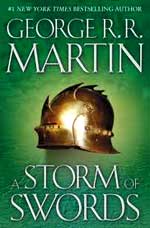
A Storm of Swords

I almost quit reading this one about halfway through, after a certain main character was presumably killed off. But I persevered, and on the last page we discover that this certain character is not dead, and a certain me ecstatically pumped her fists in the air.

Hopefully that was vague enough not to qualify as a spoiler.

I'm running out of things to say about this series. And I still have two books left! It kind of feels like everything is happening in slow-mo. I've been waiting something like 2500 pages for at least part of the Stark family to be reunited, and I'm afraid by the end of A Dance with Dragons we still won't get there. And if not...


As much as I love the world and the characters George R.R. Martin has created, I feel he could have done a much better job of introducing all those damn characters to us. J.K. Rowling's Harry Potter universe had tons of characters too, but I don't think at any point I ever had to stop and go "wait, who's that again?" Maybe it was all the alliterative and/or mythical names (Remus Lupin is a werewolf. Got it.), but moreso I think Rowling just knew how to ease readers into an unfamiliar world. In contrast, so far in A Song of Ice and Fire there's something like 4 different Brandons, a handful of Theons, and every character has something like 20 different names for themselves (Arya Stark, aka Arry, aka Weasel, aka Nan, aka Squab, aka Salty...). It's difficult to keep up.

And this is how A Feast of Crows starts out:

Dragons," said Mollander. He snatched a withered apple off the ground and tossed it hand to hand.
"Throw the apple," urged Alleras the Sphinx. He slipped an arrow from his quiver and nocked it to his bowstring.
"I should like to see a dragon." Roone was the youngest of them, a chunky boy still two years shy of manhood. "I should like that very much."
And I should like to sleep with Rosey's arms around me, Pate thought.

Hooray! Eight sentences in and we've already got FIVE brand new characters thrown at us! And by the end of the chapter the only one that has anything important happen to them is Pate (pro reading tip: anyone with a super boring name will be the first to die).

Drowning in exposition and family trees I may be, but I keep coming back for more. It's a ridiculously addictive series. And I'm trying to barrel my way through it as quickly as possible before I fall fate to any spoilers. If anybody tells me that Daeneyrs kills Dumbledore, so help me...

For those who have read the first two books/ watched the first two seasons of A Game of Thrones, you should check out this great review by Comicbookgirl19, comparing the books and the TV show:


1216 pages
3,442 / 20,000 page goal

Friday, February 8, 2013

A Clash of Kings

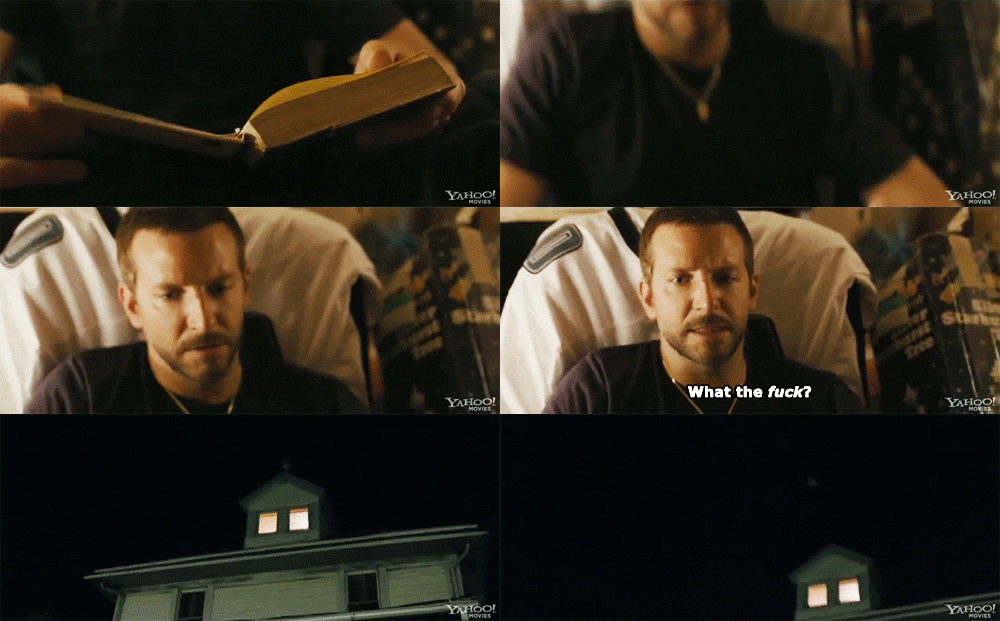
Between watching and rereading The Hobbit, playing Skyrim, and reading the A Song of Ice and Fire series, I'm feeling the urgent need to purchase a longsword and some chainmail.

After reading A Clash of Kings I'm officially hooked, and subscribed to HBO just to watch Game of Thrones (third season premiering in March!). Speaking of the series, has any other television show been more beautifully shot and well-cast? It's blowing me away. The screenwriting isn't exactly subtle (if I hear one more person ominously say "the dragons are all gone..."), but is still loads better than what's in the majority of feature-length films these days.

A serious hats off to George R.R. Martin for creating so many damn characters, cities, and mythologies, and being able to keep them all straight while writing. No seriously, there's a reason the book starts with two maps and ends with a FORTY PAGE LIST OF CHARACTERS. Good lord.

My favorite aspect of the series thus far is that all of the chapters come from the point of view of characters that are in some way powerless or disenfranchised. The social hierarchy for whatever reason has deemed them unfit, and they must fight to survive. That doesn't always mean they're sympathetic or likeable -- after all, Theon Greyjoy is one of them (I wanted so bad to just skip his chapters).

However, I'm still cringing at every mention of rape. It's always thrown in so casually, on every other page. Because apparently in Westeros rape is on par with stubbing one's toe. It's mentioned a lot in Stieg Larsson's Millennium trilogy as well, but that's because it ties directly into the story. Here it's just happening because it can. Call it a realistic portrayal of the consequences of warfare all you want -- last time I checked this was a fantasy story with fucking dragons in it. The author can make it however he pleases.

But for every sexually violent or misogynistic act there's an awesome female character to make up for it. Arya, Brienne, Osha, Catelyn, Daenyrs, Sansa, Cersei...they're all three-dimensional and well-written. A fantasy series that passes the Bechdel test with flying colors! Something that even the Harry Potter series had difficulty with.

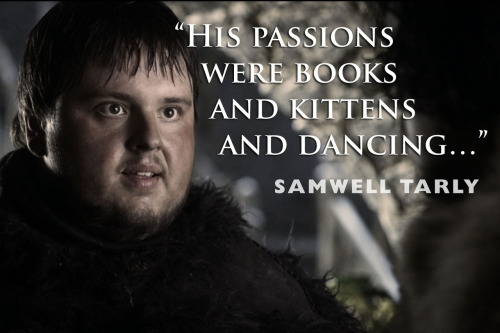
Whatever. I'm hooked. See you in April when I emerge from my winter cave, my eyes bleeding, mumbling about my crush on Samwell Tarly.

via http://red3blog.tumblr.com

As are mine, Samwell. As are mine.

1040 pages
2,226 / 20,000 page goal

Monday, January 21, 2013

A Game of Thrones - initial thoughts

I'm officially hooked on George R.R. Martin's A Song of Ice and Fire series. There are four more of them to read after A Game of Thrones, so I apologize if the blog become a bit one note for the next few weeks.

The book begins with a map, so automatically we're off to a good start.


After finishing the book I immediately bought the first season of HBO's awesome adaptation and watched it in two nights. And guess what? The show starts with a map as well! I love it. Because in this story knowing your geography is everything.


Beyond all the drama, swords, dragons and mead, my favorite aspect of the story is a theme it shares with The Hobbit: the idea that we all have different talents, roles and purposes, and none is any greater than the other. Although the ones playing the game of thrones, fighting and spilling blood for meaningless titles, continuously fail to see this. It's a world of kings trying to fit square pegs in round holes. And the square pegs fighting back.

I had some initial revulsion to the misogyny on display in the story. Not so much in the way the story was presented or the attitude of George R.R. Martin, but in the actual world he created. It's a fantasy world, but comes with all the sexism of medieval times intact. Nearly every page manages to fit in some comment about brothels, rape, forced marriages and domestic abuse. No seriously, this book was 864 pages, and I bet if I went back I could find at least 864 mentions of whores.

But, does that make the book sexist?

I'm still trying to figure this one out. I feel I need to read more of the series to get the entire picture. I mentioned that it doesn't feel it's being presented in a sexist way, because exactly half of the chapters are written from the point of view of women characters. And very different women characters at that, each playing very different and extremely important roles. But unfortunately they all get to face their own experiences of sexual discrimination. Because you can't be a woman character in anything ever without that very special experience. It builds character!!! (if you're a lazy writer!!!)

But still. At least they're there and have voices. Let me finish the series and maybe I'll write more on this aspect later.


864 pages
1186 / 20,000 page goal

Thursday, January 17, 2013

Guest Post: Blood Meridian Review

My good friend Dusty from the blog Dusty On Movies was kind enough to share his review of Cormac McCarthy's novel Blood Meridian with me. And if you already know what "holothurian" means before reading this review, shut up, no you don't.


Holothurian

Holothurians are sea cucumbers. McCarthy was apparently born with an omniscient-level vocabulary and feels he should share it with us lesser minds.

Cormac McCarthy is an oft-mentioned name in the world of movies. I've seen The Road, No Country For Old Men, and even The Sunset Limited which was based on a stage play. That alone should have been enough to get my nose in his books, but it was only after the praise of Roger Ebert that I started to seriously consider entering McCarthy's world. Ebert gave partial credit to the novels of McCarthy for carrying him through his numerous health scares. In his memoirs, "Life Itself", he talks about not being able to speak or walk and only having novels to carry his attention. Somewhere under their dark, violent exterior plots he found a voice of inspiration. One that he would turn to repeatedly during stays in hospitals and rehabilitation centers.

I didn't just want to read a random work by the author so I did a little research first. It took only some minor googling to find out Blood Meridian is widely considered his preeminent work. After a quick trip to the library I got my hands on the covers and flipped it open. I was so totally unprepared. I felt inept, illiterate even. This man writes in a way I simply have not experienced before.

I think I read the first page 20 times before I was satisfied I hadn't missed anything thanks to the advanced vocabulary. That page introduced us to "a kid" with a violent tendency who runs away from home. This kid turns out to be our main protagonist, though calling him a good guy seems misguided. We never learn his name and only rarely get a glimpse of what he's thinking. Only his actions give us some clue. It's interesting how lacking in detail the Kid's back-story is given that McCarthy spares no detail in any other circumstance.

The Kid eventually joins up with the non-fictional Glanton Gang; a group of mercenaries who get paid for scalping Native Americans, specifically Apaches. Pay is calculated per scalp. No one is safe in these battles; women, children, even infants are murdered. The atrocities are described with such vivid prose that I had to take intermittent breaks to ward off depression.

Glanton and his band of not-so-merry men eventually decide that battling Apaches, who commit atrocities of their own, is too dangerous. They eventually take to massacring villages of passive natives and even civilized towns with unprotected citizens. After all, scalps are hard to distinguish when not attached to heads. Eventually the town that contracted their work catches on to the deceit and forces them out. That doesn't stop their reign of terror, not by a long shot.

The kid's feelings on all of this are murky. I say he emerges as a protagonist, but that's only because others in his group are born of a greater evil. One is called "The Judge" and he doles out sentences without the benefit of a trial, or even a simple scrutiny. In one instance he saves a child of a demolished Apache camp and nourishes him for a while. Some members of the gang form an attachment to the child. The Judge seems to encourage this, then he kills and scalps the child.

The Judge is at once barbarous and eloquent. He carries a journal and records his findings in nature much like you'd expect Darwin did in the Galapagos. He has the ability to break out in soliloquies on the meaning of life, god, and scores of other existential subjects on a moment’s notice. I'll share an example in a moment.

The characters are colorful and extremely well-defined, but the majority of the book is taken up with landscapes. This isn't the type of western where someone hops on a horse in Albuquerque and is magically transported to Dodge. When our characters take a trip, every visual detail is noticed. Temperatures and living conditions on the journey are of constant mention. I can only describe it by offering a passage and I shall do so now. Notice the minimal punctuation in the paragraphs. It allows sentences to be read in multiple ways. It can be both burdensome and beautiful.

They began to come upon chains and packsaddles, singletrees, dead mules, wagons. Saddletrees eaten bare of their rawhide coverings and weathered white as bone, a light chamfering of miceteeth along the edges of the wood. They rode through a region where iron will not rust nor tin tarnish. The ribbed frames of dead cattle under their patches of dried hide lay like the ruins of primitive boats upturned upon that shoreless void and they passed lurid and austere the black and desiccated shapes of horses and mules that travelers had stood afoot. These parched beasts had died with their necks stretched in agony in the sand and now upright and blind and lurching askew with scraps of blackened leather hanging from the fretwork of their ribs they leaned with their long mouths howling after the endless tandem suns that passed above them. The riders rode on. They crossed a vast dry lake with rows of dead volcanoes ranged beyond it like the works of enormous insects. To the south lay broken shapes of scoria in a lava bed as far as the eye could see. Under the hooves of the horses the alabaster sand shaped itself in whorls strangely symmetric like iron filings in a field and these shapes flared and drew back again, resonating upon that harmonic ground and then turning to swirl away over the playa. As if the very sediment of things contained yet some residue of sentience. As if in the transit of those riders were a thing so profoundly terrible as to register even to the uttermost granulation of reality.

On a rise at the western edge of the playa they passed a crude wooden cross where Maricopas had crucified an Apache. The mummied corpse hung from the crosstree with its mouth gaped in a raw hole, a thing of leather and bone scoured by the pumice winds off the lake and the pale tree of the ribs showing through the scraps of hide that hung from the breast. They rode on. The horses trudged sullenly the alien ground and the round earth rolled beneath them silently milling the greater void wherein they were contained. In the neuter austerity of that terrain all phenomena were bequeathed a strange equality and no one thing nor spider nor stone nor blade of grass could put forth claim to precedence. The very clarity of these articles belied their familiarity, for the eye predicates the whole on some feature or part and here was nothing more luminous than another and nothing more enshadowed and in the optical democracy of such landscapes all preference is made whimsical and a man and a rock become endowed with unguessed kinships.

Here The Judge gets asked a question and is not short on answers:

The question was then put as to whether there were on Mars or other planets in the void men or creatures like them and at this the judge who had returned to the fire and stood half naked and sweating spoke and said that there were not and that there were no men anywhere in the universe save those upon the earth. All listened as he spoke, those who had turned to watch him and those who would not.

The truth about the world, he said, is that anything is possible. Had you not seen it all from birth and thereby bled it of its strangeness it would appear to you for what it is, a hat trick in a medicine show, a fevered dream, a trance bepopulate with chimeras having neither analogue nor precedent, an itinerant carnival, migratory tentshow whose ultimate destination after many a pitch in many a mudded field is unspeakable and calamitous beyond reckoning.

The universe is no narrow thing and the order within it is not constrained by any latitude in its conception to repeat what exists in one part in any other part. Even in this world more things exist without our knowledge than with it and the order in creation which you see is that which you have put there, like a string in a maze, so that you shall not lose your way. For existence has its own order and that no man's mind can compass, that mind itself being but a fact among others.

The Judge also offers some interesting thoughts on God and war. While persuasive, I shall remain an anti-war, peace-lovin' atheist:

The judge smiled. Men are born for games. Nothing else. Every child knows that play is nobler than work. He knows too that the worth or merit of a game is not inherent in the game itself but rather in the value of that which is put at hazard. Games of chance require a wager to have meaning at all. Games of sport involve the skill and strength of the opponents and the humiliation of defeat and the pride of victory are in themselves sufficient stake because they inhere in the worth of the principals and define them. But trial of chance or trial of worth all games aspire to the condition of war for here that which is wagered swallows up game, player, all.

Suppose two men at cards with nothing to wager save their lives. Who has not heard such a tale? A turn of the card. The whole universe for such a player has labored clanking to this moment which will tell if he is to die at that man's hand or that man at his. What more certain validation of a man's worth could there be? This enhancement of the game to its ultimate state admits no argument concerning the notion of fate. The selection of one man over another is a preference absolute and irrevocable and it is a dull man indeed who could reckon so profound a decision without agency or significance either one. In such games as have for their stake the annihilation of the defeated the decisions are quite clear. This man holding this particular arrangement of cards in his hand is thereby removed from existence. This is the nature of war, whose stake is at once the game and the authority and the justification. Seen so, war is the truest form of divination. It is the testing of one's will and the will of another within that larger will which because it binds them is therefore forced to select. War is the ultimate game because war is at last a forcing of the unity of existence. War is god.

So did I enjoy Blood Meridian? Well, no. I did find my self frequently struck with awe. It's an incredibly arduous read. I consulted an online dictionary multiple times per chapter and, in some chapters, per page. If only a fraction of that vocabulary wears off on me it will have been worth it. Really, Blood Meridian is a piece of classic literature that happens to be less than 50 years old. It has an undefinable literary value that ranks it among the classic works of Faulkner, Tolstoy, Shaw or any esteemed author of your choice. I don't think I'd read it again, but reading it once is a must.

Friday, January 11, 2013

A Gate at the Stairs

Finished Lorrie Moore's excellent A Gate at the Stairs. I've always heard great things about Moore, so when I was at a book fair a few weeks back I bought something like 3 of her books, even though I'd never read her before. But A Gate at the Stairs wasn't one of them, ironically. Instead I checked it out as an ebook from the library.

Note: ever think to check out the selection of ebooks your local library offers? If they have Overdrive, chances are it's a pretty awesome collection.

I fell so in love with Moore's prose reading this novel that afterward, checking the reviews on Goodreads and Amazon, I was seriously taken back when I saw all the vitriol aimed toward the book. The argument was mostly against the story, not her writing.

The story follows Tassie, a 20 year old woman who leaves the farm she grew up on to attend a state college. To help pay for her apartment she takes on a babysitting job, but under unusual circumstances. The white parents are adopting a bi-racial child and ask Tassie to take part in every step; including flying across the country for parent interviews. Her experiences watching the child, dealing with racism, the harsh reality of dating and love, and separation from family make her less and less naive during this first year of college. It's at times fiercely funny, and other times devastatingly sad.

I'm having such a hard time figuring out why people didn't like this novel. Several of the reviewers say they feel like none of the characters' actions or the events ever had "consequences." I guess people like feel-good morals and endings tied up in red bows. There is no "good" or "bad" in the book; a sentiment repeated by Tassie's boyfriend (who could be perceived as one of the "bad" characters, depending on how you look at it). Instead there's just the terrible things we do to each other, and the good things that we too often don't. Neglect becomes a prominent theme.

The racism depicted in the book were at times a bit too overstated and unreal, although maybe I'm being the naive one now. The subtle racism of the uber-liberals saturating the college town were the most believable, and the best written segments. Maybe that's why so many readers hated it: it holds up an ugly mirror to ourselves.

Here are some passages I liked:

Nothing had really prepared me. Not the college piggy bank in the dining room, the savings bonds from my grandparents, or the used set of World Book encyclopedias with their beautiful color charts of international wheat production and photographs of presidential birthplaces. The flat green world of my parents' hogless, horseless, farm--its dullness, its flies, its quiet ripped open daily by the fumes and whining of machinery--twisted away and left me with a brilliant city life of books and films and witty friends. Someone had turned on the lights. Someone had led me out of the cave--of Perryville Road. My brain was on fire with Chaucer, Sylvia Plath, Simone de Beauvoir. Twice a week a young professor named Thad, dressed in jeans and a tie, stood before a lecture hall of stunned farm kids like me and spoke thrillingly of Henry James's masturbation of the comma. I was riveted. I had never before seen a man wear jeans with a tie.

I never did get a professor who wore jeans with a tie. I did get my share of tweed and elbow patches, though. And not only from the professors.


  ...my mother had given me a carefully wrapped present of a pearl necklace and watched, teary-eyed, as I opened it. "Every woman should have a pearl necklace," she said. "When I was your age I got one." From my father, I knew. And now, with no man in my life, even though I was only twenty, she would be the one to bestow this artifact of womanhood, this rite of passage, this gyno-noose, upon me. That I might in fact never have an occasion to wear such a thing or that I might look like the worst sort of Republican doing so probably never occurred to her. I think she saw it as a kind of ticket off the farm and out into the world, wherever that was.

"Thanks, Mom," I said, and kissed her cheek, which was simultaneously powdery and damp. I thrust the velveteen box of pearls high, as if making a toast. "Here's to Jesus," I said.

My mom looked at me from a great and concerned distance.

I think "My mom looked at me from a great and concerned distance" will be the title of my memoir.


We hiked down past the copse of sycamore and oak (as children, animating some dormant urban fear, we had witlessly shrieked, "The copse! The copse!" and raced through the underbrush, thrilled by our down concocted, dreadless terror). Now Robert and I weaved among piss elms toward the old fish hatchery, which in winters of the past we would have acted on; it was a former nineteenth-century mill pond that had long ago lost its falls, though the old paddle wheel still leaned against a tree, coated with squirrel shucks. Sometimes we'd tobogganed down the snowy trail all the way to the hatchery, where now there was no snow at all, just the matted hard grass and dirt and the dried, icing stalks of angelica and milkweed and bee balm. My brother liked to fish at the hatchery sometimes, even in winter, sometimes even in the stream, even if the fish were really now just trash fish, and even though it was stupid to ice fish in a stream,. But summers down this path I had always liked, and when the gnats weren't bad I had sometimes accompanied him, sat in the waist-high widgeon grass beside him, the place pink with coneflowers, telling him the plot of, say, a Sam Peckinpah movie I'd never seen but had read about once in the Dellacrosse Sunday Star. Crickets the size of your thumb would sing their sweet monotony from the brush. Sometimes there was a butterfly so perfect and beautiful, it was like a party barrette you wanted to clip in your hair. Above and around us green leaves would flash wet with sunsetting light. In this verdant cove I recounted the entire plot of Straw Dogs.

I just like that entire thing. The whole novel is filled with wonderful paragraphs like that.

If he had loved me, or even if he'd just have said so, I would have died of happiness. But it didn't happen. So I didn't die of happiness. Words for a tombstone: SHE DIDN'T DIE OF HAPPINESS.

322 pages
322/20,000 page goal

Tuesday, January 1, 2013

Reading Challenge for 2013


Back in 2011 I challenged myself to read 100 books. And failed. Miserably. So for this year I thought, why not let my soul be crushed again by another spectacular failure? Great idea!

My soul can take it.

But I'll switch it up a little this time. This year instead of a set number of "books" (which believe it or not was hard to define when it came down to it), I will vow to read a set number of pages. 20,000 to be exact. 

Twenty K seems like a good number. It's how many leagues under the sea Jules Verne chose for his story, and according to wikipedia is the number that comes after 19,999 and before 20,001. Perfect!

This should leave enough freedom for me to read what I want, whether it be something 1200 pages long or a 70 page novella. Or half a poetry anthology. Or the back of a cereal box. It'll all count! (exaggerating a bit).

So maybe this blog will pick back up again, because I realize it's been deadly as of late. Thanks for sticking with me, dear sparse followers.

Happy new year!