Google+
Showing posts with label Ursula Le Guin. Show all posts

Thursday, October 17, 2013

The Lathe of Heaven

The premise of Ursula K. Le Guin's The Lathe of Heaven is a simple one: what if someone could change the world with their dreams? But the resulting speculative novel is anything but simple.

George Orr is an average guy. Almost spectacular in his averageness. Except that when he has particularly vivid dreams, whatever happens inside them manifests itself into reality when he wakes. Frightened of his power, he seeks help from a psychologist, who in turns wants to harness this incredible opportunity to change the world. But power, even used with noble intentions, can have devastating consequences.

The entire story leaves you on edge, questioning what's real, the reliability of the protagonist, and ultimately the reliability of the world outside the story. Reading it I felt like Bastian making his way through the Neverending Story, seeing himself mentioned, and just being like


My first thought after reading was, how has this not been turned into a movie yet? Especially after the success of Inception in 2010? Then I did my research and found out it has. Twice. Neither being a blockbuster by any means. But the first attempt, a 1980 public television flick with a shoestring budget, actually turned out to be pretty decent. Oh, the special effects are somewhat hilarious, but it follows very closely to the book. And I bow down to anyone trying to make a film that involves volcanoes, space wars, aliens, nuclear disaster and beautiful ponies with $250k. You can watch the entire thing on Youtube.

Here are some passages that will hopefully convince you to become a Le Guin-head like me.


"But in fact, isn't that man's very purpose on earth--to do things, change things, run things, make a better world?"
"No!"
"What is his purpose, then?"
"I don't know. Things don't have purposes, as if the universe were a machine, where every part has a useful function. What's the function of a galaxy? I don't know if our life has purpose and I don't see that it matters. What does matter is that we're a part. Like a thread in a cloth or a grass-blade in a field. It is and we are. What we do is like wind blowing on the grass."


That Haber could have thus got out of communication with himself was rather hard for Orr to conceive; his own mind was so resistant to such divisions that he was slow to recognize them in others. But he had learned that they existed. He had grown up in a country run by politicians who sent the pilots to man the bombers to kill the babies to make the world safe for children to grow up in.


There is a bird in a poem by T. S. Eliot who says that mankind cannot bear very much reality; but the bird is mistaken. A man can endure the entire weight of the universe for eighty years. It is unreality that he cannot bear.


192 pages
7,309 / 20,000 page goal

Tuesday, October 25, 2011

Earthsea Series, 52-55/100

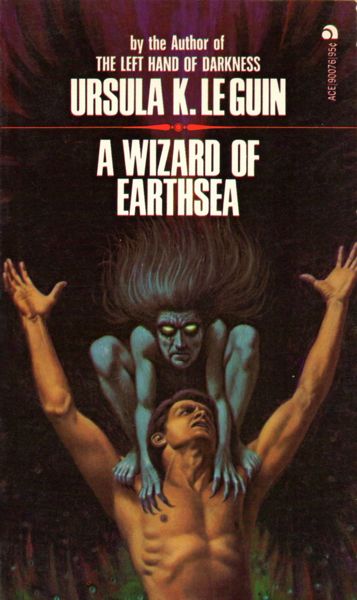
I kind of love this cover art for the first book. It reminds me of Fuseli's The Nightmare. Only one problem: the main character isn't white! Oh, book publishers. Forever whitewashing the world.

When I first started reading Ursula Le Guin's Earthsea series about a year ago, I decided to wait and do a blog post when I finished all the books. Now I wish I hadn't, not realizing quite how many there were. I"ll be stretching my brain trying to remember everything.

These are the books in the series:

A Wizard of Earthsea (1968)
The Tombs of Atuan (1971)
The Farthest Shore (1972)
Tehnau (1990)
Tales from Earthsea (2001)
The Other Wind (2001)

Only the last four were read this calendar year.

The Earthsea series is fantasy aimed towards young adults. It molds itself after Tolkien and preludes Rowling. At the beginning of each book is a lovely, sprawling map of the fictional world of Earthsea, drawn by Le Guin herself.

Don't hurt your eyes. Click the pic to make it much, much larger.

Don't you love big maps like that? I could look at them all day. Earthsea is an archipelago of islands that necessitates all travel be made by boat; or flight if you happen to be a dragon. Oh yes! There are dragons. You can't go wrong with wizards and dragons.

Most of the stories revolve around the wizard Ged, who as a young boy travels to a wizarding school to learn magic. His school adventures don't span 7 books, however, and by the third book Ged is middle-aged. It's nice to come across a YA book that isn't so obsessed with youth. I think more literary fiction should feature young adults and vice-versa.

One of my favorite aspects of Earthsea is how the magic system works. Le Guin explains fully how the magic works in this world, instead of just claiming some things to be magic and some not. Here magic is performed by learning and using the "one true language": the language that existed before men created their own. Every rock, tree, person and animal has its own "true name" that allows any wizard or witch who knows it to have complete control over it.

But there is a downside to this system. It's knowledge based. Wizards learn the true words through memorization, which means that the knowledge can be withheld from anyone who isn't deemed worthy.

In the first 3 books, written between 1968-1972 (The Farthest Shore was originally subtitled "The Last Book of Earthsea"), Le Guin was criticized for making this wizarding world almost exclusively male. There are village witches, but they are considered lowly, working mostly as mid-wives and healers. "Weak as women's magic, wicked as women's magic."

Tehanu, written 18 years later, was her response to the outcries of sexism from critics and concerned fans. The novel focuses on the gender discrimination and segregation within Earthsea. She reveals that both sexes hold the talent to perform magic, but only one is privileged enough to be taught how.

Le Guin has apologized before for the supposed sexism in the earlier novels:

What happened in the 17 years between Farthest Shore and Tehanu was that feminism was reborn, and I became 17 years older, and learned a good deal. One of the things I learned was how to write as a woman, not as an honorary, or imitation, man.

From a woman's point of view, Earthsea looked quite different than it did from a man's point of view. All I had to do was describe it from the point of view of the powerless, the disempowered - women, children, a wizard who has spent his gift and must live as an "ordinary" man.

But reading the first three, I kind of "got it." I understood the sexism at play; that it was the work of the characters, not the author. Tehanu addresses the issue nicely, although perhaps a bit too thoroughly, sacrificing story for preachiness. And it's a bit sad that the big "feminist" book in the collection is basically 300 pages of two women trying to fend off a rapist until a prince comes and saves them. An over simplification, but that's what it boils down to.

From Tehanu:
She felt as she had felt in Havnor as a girl; a barbarian, uncouth among their smoothnesses. But because she was not a girl now, she was not awed, but only wondered at how men ordered their world into this dance of masks, and how easily a woman might learn to dance it.

You've probably noticed some similarities between this series and Harry Potter. Both feature schools for young wizards. The prejudice against women resembles the discrimination against mudbloods (the founders of the school on Roke debated over accepting women, declined, and kicked out the founders who WERE women. At Hogwarts it goes the other way, with the anti-mudblood Salazaar Slytherin renouncing his position).

Another aspect both series share is their focus on immortality vs. death. In Harry Potter, the entire story springs from an evil wizard's desire to be immortal. The Philosopher's Stone, horcruxes, the Deathly Hallows--all attempts to cheat death. Dumbledore, ever the voice of reason, reminds us that death should not be feared, but looked to as "the next great adventure." In Earthsea the moral is much the same: cheating death, destroying the balance, will have dire consequences.

From The Farthest Shore:
You will die. You will not live forever. Nor will any man nor any thing. Nothing is immortal. But only to us is it given to know that we must die. And that is a great gift: the gift of selfhood. For we have only what we know we must lose, what we are willing to lose....That selfhood which is our torment, and our treasure, and our humanity, does not endure. It changes; it is gone, a wave on the sea. Would you have the sea grow still and the tides cease, to save one wave, to save yourself? Would you give up the craft of your hands, and the passion of your heart, and the light of sunrise and sunset, to buy safety for yourself—safety forever?

In the first book, Ged summons a dead spirit, unleashing a shadow into the world that seeks to destroy him. In The Farthest Shore, Ged must travel into the afterlife to defeat an evil wizard who, in his quest for immortality, has taken magic from the world. We return to the afterlife in The Other Wind, when it's discovered that a decision made thousands of years ago to create life after death has sentenced generations of people to purgatory.

Moral of the stories: You're gonna die. Just deal with it.

From The Other Wind:
"I think...that when I die, I can breathe back the breath that made me live. I can give back to the world all that I didn't do. All that I might have been and couldn't be. All the choices I didn't make. All the things I lost and spent and wasted. I can give them back to the world. To the lives that haven't been lived yet. That will be my gift back to the world that gave me that life I did live, the love I loved, the breath I breathed."

I've always loved how works of fantasy draw on each other, and can take tropes of the genre and will them into a new creation. No work exists that wasn't inspired or adapted from something else. Earthsea is very much tied to Middle-earth. And Rowling's creation was undeniably influenced by the works of several fantasy authors. I don't think she has ever tried to hide the fact. But I've read a few interviews with Le Guin where she expresses a bit of animosity towards Rowling that I find deeply unfortunate. There's nothing grosser than rivalries between authors.

Example: The 50 Best Author Put Down of All Time. It's kind of funny, but it's also really sad and pathetic. Like some kind of nerd rap battle. You don't have any microphone to drop, Mark Twain, so just stop. Leave the insulting to the critics and your fans.

Thinking every piece of fiction that comes along is going to be sublimely original is ridiculous. It's all about what you do with your inspiration. Just take a look at Lev Grossman's The Magicians. It very actively and openly drew from the world of Harry Potter, Narnia, and Middle-earth. But no one's complaining, because he ran with the idea of merging these worlds, creating something new that celebrates the entire fantasy genre. I love it.

So get over it, jealous fantasy authors. You're not the first person who's ever written about a dragon.

Saturday, September 24, 2011

Why I love Ursula Le Guin

From her forward to Tales from Earthsea:

In the years since I began to write about Earthsea I've changed, of course, and so have the people who read the books. All times are changing times, but ours is one of massive, rapid moral and mental transformation. Archetypes turn into millstones, large simplicities get complicated, chaos becomes elegant, and what everybody knows is true turns out to be what some people used to think.

It's unsettling. For all our delight in the impermanent, the entrancing flicker of electronics, we also long for the unalterable. We cherish the old stories for their changelessness. Arthur dreams eternally in Avalon. Bilbo can go "there and back again," and "there" is always the beloved familiar Shire. Don Quixote sets out forever to kill a windmill...So people turn to the realms of fantasy for stability, ancient truths, immutable simplicities.

And the mills of capitalism provide them. Supply meets demand. Fantasy becomes a commodity, an industry.

Commodified fantasy takes no risks: it invents nothing, but imitates and trivialises. It proceeds by depriving the old stories of their intellectual and ethical complexity, turning their action to violence, their actors to dolls, and their truth-telling to sentimental platitude. Heroes brandish their swords, lasers, wands, as mechanically as combine harvesters, reaping profits. Profoundly disturbing moral choices are sanitized, made cute, made safe. The passionately conceived ideas of the great story-tellers are copied, stereotyped, reduced to toys, molded in bright-colored plastic, advertised, sold, broken, junked, replaceable, interchangeable.

What the commodifiers of fantasy count on and exploit is the insuperable imagination of the reader, child or adult, which gives even these dead things life--of a sort, for a while.

Imagination like all living things lives now, and it lives with, from, on true change. Like all we do and have, it can be co-opted and degraded; but it survives commercial and didactic exploitation. The land outlasts the empires. The conquerors may leave desert where there was forest and meadow, but the rain will fall, the rivers will run to the sea. The unstable, mutable, untruthful realms of Once-upon-a-time are as much a part of human history and thought as the nations in our kaleidoscopic atlases, and some are more enduring.

Friday, August 26, 2011

Favorite Summer Read


Friend and co-worker (and author!) Cherie Reich is holding a Favorite Summer Reads Blogfest over at her blog Surrounded by Books Reviews. I've certainly read enough this summer -- more than I ever have. Despite not taking any vacations. NONE. It failed to be a summer of beach-going, sandal-wearing, or skinny dipping (everyone rejoices), instead turning into a summer of me sitting in my air conditioned apartment killing zombies in video games. (note: the sheer amount of violence I have vicariously inflicted upon the grim CGI bodies of the undead should be enough to put me on some kind of FBI watchlist by now. Chainsaws, guys. CHAINSAWS.)

So none of what I have read in the past 3 months really strikes me as something I'll remember years from now having read in the summer. At least that's my definition of a summer read (or any season read for that matter): a book that for whatever reason ties itself to the period of time you're reading it. Example: Anne Rice books are late winter books. I read the vampire chronicle books during the most depressing part of the year, kickstarting a spiral of depression that culminated in me dreaming I was trying to bury myself alive. JOY!

There are other books I specifically remember reading in the summers of past: there's The Guernsey Literary and Potato Peel Pie Society that I read last year, Alex Garland's The Beach, which I read at the...beach, Harry Potter rereads before the July films, and rereads of Jane Eyre and The Hobbit in high school.

But the one that sticks out the most in my mind is reading Ursula LeGuin's The Left Hand of Darkness one summer at the beach. It's a fairly odd choice, being a science fiction novel set on a planet called WINTER. Let's just say the descriptions of chilly landscapes and Antarctic weather were as good as AC in that horrible beachy heat.

This was the book that got me back into reading science fiction. Telling the story of an envoy to the planet Winter, we follow his interactions with its race of androgynes, their government, religion, and civilization. The entire novel is a study of gender, society, power, and human relationships; even when those relationships aren't between humans. Everything that happens on the fictional planet of Winter is a finger pointing directly back at Earth. The goal of all good speculative fiction.

I'll have to do a reread of this fantastic novel so I can list some passages. But don't wait for that. Go read it now. I think it's the only book I could recommend to positively everyone. No "well if you fancy aliens you might like this," or "stay away if you hate Star Trek." If you like printed words on pages, then you should probably read this book.

And now I'm going to bury you under an AVALANCHE (pun) of awesome book covers!


I have to admit I don't remember there being a guy on fire waving a lightning bolt. Guess I really should reread it.

Wednesday, June 15, 2011

Very Far Away from Anywhere Else, 24/100

So how are you liking these late 1970s-ish book covers? They doing anything for ya? That guy's sweater needs to be burned.

And whoops! Looks like a skipped #24 is my count to 100. So here it is.

Very Far Away from Anywhere Else is one of the few non-SciFi titles from Ursula LeGuin. I read her novel Malafrena a few years back not knowing it was entirely historical fiction (albeit an imaginary history), and kept expecting wizards or aliens to pop-up at some point.

This short novella is about a teenage boy trying to cope with being an outsider and what his parents/society expect of him. You know, that age-old tale. He meets a girl who's dealing with the same issues and they become friends. They have deep, personal, and philosophical conversations... and yeah you know exactly where this is going before I even finish. Because it's a guy. And a girl. And they're teenagers. The big "can guys and girls be JUST friends?" problem comes up and their friendship suffers under it.

It's a short book but it packs quite a bit in. The story becomes a conversation over what "love" actually is, what it means to be alone vs. part of a group, and the responsibility we have towards others as well as to ourselves. LeGuin captures the teenage experience honestly and realistically. Anyone who has ever been seventeen knows this story.

I think what you mostly do when you find you really are alone is to panic. You rush to the opposite extreme and pack yourself into groups--clubs, teams, societies, types. You suddenly start dressing exactly like the others. It's a way of being invisible. The way you sew the patches on the holes in your blue jeans becomes incredibly important. If you do it wrong you're not with it. You have to be with it. That's a peculiar phrase, you know? With it. With what? With them. With the others. All together. Safety in numbers. I'm not me. I'm a basketball letter. I'm a popular kid. I'm my friend's friend. I'm a black leather growth on a Honda. I'm a member. I'm a teenager. You can't see me, all you can see it us. We're safe.

And if We see You standing alone by yourself, if you're lucky we'll ignore you. If you're not lucky, we might throw rocks. Because we don't like people standing there with the wrong kind of patches on their blue jeans reminding us that we're each alone and none of us is safe.

I guess I tend to think that important events should be solemn, and very grand, with muted violins playing in the background. It's hard to realize that the really important things are just normal little happenings and decisions, and when they turn on the background music and the spotlights and the uniforms, nothing important is going to happen at all.

Wednesday, March 3, 2010

Le Guin on Google Books Settlement


Ursula K. Le Guin, science fiction writer and all-around badass, addresses the Google Books Settlement in an interview:

"The future" in most science fiction is just a metaphor for "us, here, now." The possibility of digitizing books to make them available to everybody, a limitless Public Library, is us, here, now. It's our baby. Let's bring the baby up right, in the public interest -- not hand it to a corporation whose interest is in controlling information and horning in on writers' profits.

I'm part of the technological age whether I want to be or not, and mostly I enjoy it very much. I'm not protesting technology -- how stupid would that be? Writers against Computers, or something? I'm protesting against a corporation being allowed to rewrite the rules of copyright and the laws of my country -- and in doing so, to wreck the whole idea of that limitless electronic Public Library.
She goes on to reveal what she hopes will become of her books after her death:

I want them to be available, I want cheap paper editions of them, I want them to be continuously downloaded in forty different languages, I want them to be read, I want them to be argued about, I want people to cry over them, I want unreadable dissertations written about them, I want people to get angry with them, I want people to love them.

There is no doubt all of these things will happen.

For anyone who has never read Le Guin's Left Hand of Darkness, go read it. Now.